
Spring Mulching: Best Practices for Lincoln, NE
Mulch does more work than any other material in your landscape. It suppresses weeds, retains moisture, moderates soil temperature, prevents erosion, and slowly improves soil structure as it breaks down. A properly mulched bed needs less water, less weeding, and less overall maintenance than bare soil.
But mulching wrong—too much, too early, the wrong type, or piled against plant stems—causes problems that range from annoying to plant-killing. Every spring in Lincoln, well-meaning homeowners damage their landscapes with improper mulching technique.
Here’s how to get spring mulching right in Lincoln, NE, from timing to material selection to application.
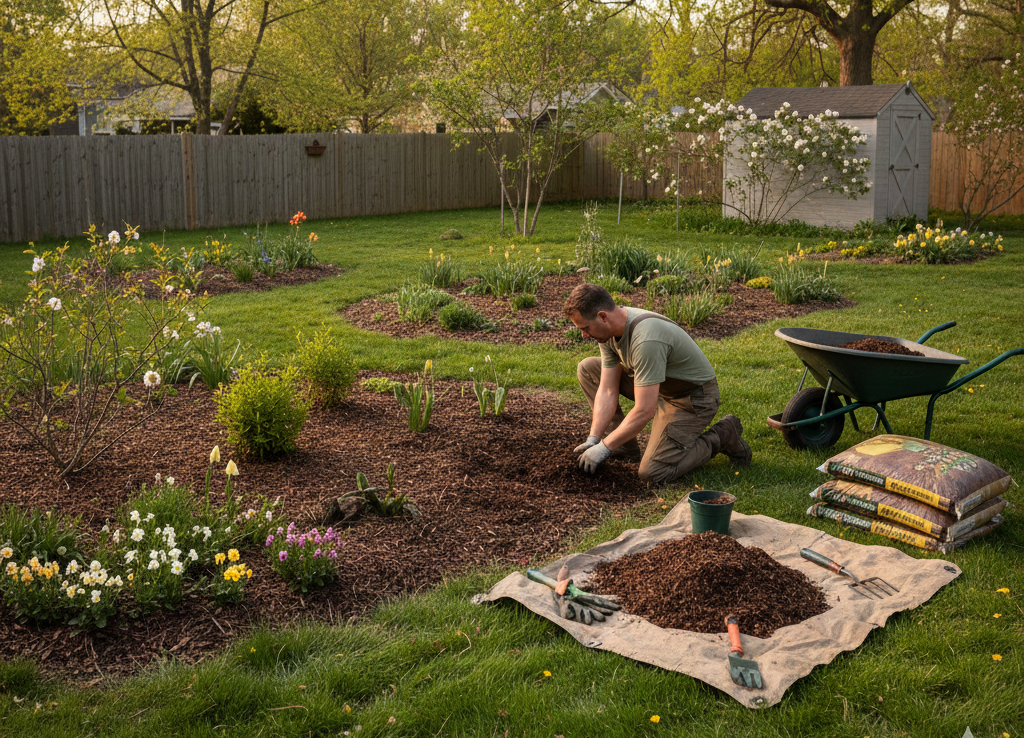
When to Mulch in Nebraska
Timing matters for spring mulching. Apply too early and you trap cold in the soil, delaying plant emergence and root growth. Apply too late and you miss the window for effective weed suppression.
In Lincoln’s Zone 5b climate, the ideal window for spring mulching falls between mid-April and mid-May. The exact timing depends on that year’s weather pattern.
Wait for Soil to Warm
Mulch insulates soil in both directions—it keeps warm soil warm and cold soil cold. If you apply mulch while the ground is still cold from winter, you lock that cold in place. Perennials emerge later, root systems stay dormant longer, and plants get a slower start to the season.
Before mulching, soil temperature at 4 inches deep should reach 55-60°F consistently. In Lincoln, this typically happens in late April during average years, earlier in warm springs, later in cool ones.
You can check soil temperature with an inexpensive probe thermometer, or use the Nebraska Mesonet stations around Lancaster County for general guidance. As a visual cue, wait until spring bulb foliage is fully emerged and early perennials like bleeding heart and creeping phlox are actively growing.
Coordinate with Pre-Emergent Herbicide
If you use pre-emergent weed control in your beds, mulch goes down after the herbicide, not before. Pre-emergents need to reach the soil surface to create their barrier against germinating seeds. Mulch applied first blocks that contact.
The typical sequence: apply pre-emergent when soil temperature reaches 55°F (usually late April in Lincoln), water it in, then mulch a few days later. This timing catches the spring flush of annual weeds before they germinate while still protecting plants through summer.
Don’t Wait Too Long
Pushing mulching into June sacrifices much of the weed suppression benefit. By then, annual weed seeds have already germinated, and you’re just mulching over baby weeds that will grow right through.
Late mulching also means your soil loses moisture during the driest part of spring before the summer rain pattern establishes. Lincoln typically sees a dry spell in late May and early June—unmulched beds suffer during this window.
Choosing Mulch Materials for Lincoln Landscapes
Not all mulches perform equally, and the best choice depends on your specific situation. Here’s how the common options compare for Lincoln conditions.
Hardwood Mulch
Shredded hardwood is the most popular mulch in Lincoln, and for good reason. It’s affordable, readily available, stays in place reasonably well, and breaks down at a moderate pace that adds organic matter to soil.
Hardwood mulch typically comes from a mix of species—oak, maple, ash, and whatever else was processed at the mill. The exact composition varies by supplier and season.
Fresh hardwood mulch can temporarily tie up nitrogen as it decomposes, sometimes causing yellowing in plants. This effect is minor and short-lived in established beds but can stress new plantings. If you’re mulching newly installed beds, use aged or composted hardwood, or add a light nitrogen application.
Cost in Lincoln: $30-45 per cubic yard delivered for bulk mulch, or $4-6 per 2-cubic-foot bag from garden centers.
Cedar Mulch
Cedar resists decay longer than hardwood, lasting 2-3 years before needing significant replenishment. The natural oils that provide this decay resistance also deter some insects, though the effect diminishes as the mulch weathers.
Cedar’s main drawbacks are cost and availability. It runs roughly 50% more than hardwood mulch and isn’t always stocked by local suppliers. The reddish-brown color fades to gray within a year.
Cost in Lincoln: $45-65 per cubic yard delivered.
Pine Bark Mulch
Pine bark comes in various sizes, from finely shredded to large nuggets. The shredded form stays in place well; the nuggets tend to float and scatter in heavy rain.
A persistent myth claims pine bark acidifies soil significantly. In reality, the pH effect is minimal and temporary—not enough to harm plants or meaningfully benefit acid-lovers. Use pine bark if you like the appearance, not because you’re trying to change soil chemistry.
Pine bark breaks down more slowly than hardwood, requiring less frequent replenishment. It’s lighter in weight, which makes it easier to spread but more prone to washing or blowing out of beds.
Cost in Lincoln: $35-50 per cubic yard delivered for shredded; nuggets run slightly higher.
Dyed Mulches
Red, black, and brown dyed mulches maintain their color longer than natural materials. The dyes used today are typically vegetable-based or iron oxide and are considered safe for plants and soil.
The bigger concern with dyed mulch is what’s underneath the dye. Some dyed mulches are made from recycled pallets and construction debris that may contain contaminants, treated lumber, or foreign materials. Ask your supplier about the source material.
Aesthetically, dyed mulches look artificial to many eyes. The bright colors don’t occur in nature and can clash with plant material. That said, some homeowners prefer the uniform appearance.
Cost in Lincoln: $30-45 per cubic yard delivered—comparable to natural hardwood.
Rubber Mulch
Rubber mulch made from recycled tires lasts essentially forever, doesn’t decompose, and won’t float away in rain. It’s sometimes promoted for playgrounds and high-traffic areas.
For landscape beds, rubber mulch has significant drawbacks. It doesn’t improve soil as it breaks down (because it doesn’t break down). It can leach zinc and other compounds into soil, potentially reaching toxic levels over time. It absorbs and radiates heat, raising soil temperatures beyond what plants prefer. And it looks like shredded tires, because that’s what it is.
We don’t recommend rubber mulch for planting beds in Lincoln or anywhere else.
Rock and Gravel
Stone mulches—river rock, lava rock, pea gravel—last indefinitely and work well in certain applications. Around foundations, in xeriscape beds, and in areas where organic mulch would create moisture problems against structures, rock is often the better choice.
For flower beds and shrub plantings, rock has problems. It doesn’t suppress weeds as effectively as organic mulch—seeds germinate in the dust and debris that accumulates between stones. It heats up dramatically in summer, stressing plant roots. It doesn’t improve soil. And once installed, it’s difficult to remove if you change your mind.
Rock also migrates into lawns over time, where it becomes a mower hazard. The lawn-bed interface requires permanent edging to contain stone mulch.
Cost in Lincoln: $50-100 per cubic yard delivered depending on type, plus fabric underlayment and edging installation.
Compost as Mulch
Finished compost can serve as mulch, and it’s the most soil-building option available. Compost adds nutrients, feeds soil biology, and improves soil structure all at once.
The tradeoff: compost doesn’t suppress weeds as well as woody mulches. Its fine texture allows weed seeds to germinate more easily. And it breaks down faster, requiring more frequent replenishment.
A practical compromise is to apply a thin layer of compost (1 inch) directly on soil, then cover with 2 inches of woody mulch. You get the soil-building benefits of compost with the weed suppression of mulch.
Cost in Lincoln: $25-40 per cubic yard for bulk compost; higher for bagged products.
How Much Mulch Do Lincoln Beds Need?
The standard recommendation is 2-4 inches of mulch depth for woody mulches. Within that range, adjust based on your situation.
Depth Guidelines
For most flower beds and shrub plantings in Lincoln: 2-3 inches of new mulch provides good weed suppression and moisture retention without creating problems.
For new plantings and bare soil: 3-4 inches is appropriate because you’re starting from zero and need full coverage.
Around established trees: 2-3 inches in a ring extending to the drip line (or as far as practical), but never touching the trunk.
In beds with existing mulch: add only enough to bring total depth to 3-4 inches. If existing mulch is already 2-3 inches deep, you might only need an inch of fresh material.
Calculating How Much to Buy
Mulch coverage depends on depth:
- 1 cubic yard at 2 inches deep covers approximately 160 square feet
- 1 cubic yard at 3 inches deep covers approximately 108 square feet
- 1 cubic yard at 4 inches deep covers approximately 80 square feet
To calculate your needs: measure your bed area in square feet, divide by the coverage factor for your intended depth, and round up to the nearest half-yard.
Example: A 300-square-foot bed area mulched at 3 inches needs about 2.8 cubic yards (300 ÷ 108). Order 3 yards to have enough without running short.
Always order slightly more than your calculation suggests. Mulch settles, some gets spilled, and you’ll find spots that need more than you estimated. Having a half-yard left over is better than running short and making another trip or delivery.
Signs You’re Using Too Much Mulch
More is not better with mulch. Excessive depth causes real problems.
Water repellency: Thick mulch layers, especially aged material, can become hydrophobic. Rain runs off rather than soaking through to the soil beneath. You can test this by watering a thick-mulched bed and checking whether the soil underneath actually gets wet.
Oxygen deprivation: Plant roots need oxygen. Mulch layers beyond 4 inches can limit air exchange with the soil, stressing roots and promoting root diseases.
Rodent habitat: Thick mulch provides cover for voles and mice that feed on plant roots and bark, especially during winter. If you’ve had rodent damage in beds, keep mulch on the thinner side.
Stem and trunk rot: This is the most common mulch-related plant damage. Mulch piled against stems creates moisture conditions that promote fungal and bacterial diseases. More mulch means more opportunity for it to contact plant tissue.
Proper Mulching Technique
How you apply mulch matters as much as what type you choose and how deep you go.
The Critical Rule: Keep Mulch Off Stems and Trunks
Every plant—from perennials to shrubs to mature trees—needs a mulch-free zone at its base. Mulch holds moisture against bark and stems, creating conditions for rot, disease, and pest damage.
For trees: create a 3-6 inch gap between mulch and trunk. The flare where the trunk meets the roots should be visible, not buried.
For shrubs: maintain a 2-3 inch gap around the base of stems.
For perennials: pull mulch back from emerging shoots and crown area.
The “mulch volcano”—mulch piled against tree trunks in a cone shape—is one of the most damaging landscape practices in common use. Drive through any Lincoln neighborhood and you’ll see dozens of trees slowly being killed by mulch volcanoes. Professional landscapers should know better, but many apparently don’t.
Preparing the Bed Before Mulching
Before spreading new mulch:
Remove weeds that have already germinated. Mulch suppresses new weeds but won’t kill existing ones—they’ll grow right through.
Edge the beds to create a clean line between mulch and lawn. This also creates a slight trench that helps contain mulch.
Fluff existing mulch with a rake to break up any crusting or matting. Compacted old mulch can repel water.
Apply any pre-emergent herbicide and water it in.
Spreading Techniques
Dump bulk mulch in piles around the bed, then spread with a rake. Trying to shovel directly from a wheelbarrow into planting spaces takes longer and makes uneven coverage more likely.
Work from the back of beds toward the front so you’re not compacting mulch you’ve already spread.
Use a hard rake (garden rake or level rake) for spreading, not a leaf rake. The stiffer tines move mulch more efficiently.
Taper mulch thinner at the edges of beds and where it meets plant stems. Full depth should be in the open areas between plants.
After spreading, water lightly to settle the mulch and wash any debris off plant foliage.
Spring Mulching Around Trees
Trees benefit from mulch, but they need different treatment than flower beds.
Create a Mulch Ring, Not a Volcano
The ideal tree mulch application looks like a donut: mulch extending from near the trunk (but not touching it) out to at least the drip line or beyond, with a visible well around the trunk itself.
Spread mulch 2-4 inches deep in this ring. Keep it pulled back 3-6 inches from the trunk so the root flare remains visible and above the mulch surface.
The mulched area should be as large as practical. A tree’s feeder roots extend well beyond the canopy—they don’t stop at the drip line. A mulch ring extending 3-6 feet from the trunk on a shade tree provides significant benefit.
Converting Tree Rings to Mulch
Removing grass from around trees and mulching instead is one of the best things you can do for tree health. Grass competes aggressively with trees for water and nutrients. A mulched ring eliminates this competition and protects the trunk from mower and trimmer damage.
To convert: remove existing sod with a flat spade, cutting the roots rather than pulling (which disturbs soil). Alternatively, cover the grass with cardboard, wet it thoroughly, and mulch over it. The cardboard smothers the grass and breaks down over the season.
Avoiding Common Tree Mulching Mistakes
Beyond the mulch volcano, watch for these problems:
Piling mulch over the root flare: The flare where trunk meets roots should be visible. If previous mulching has buried it, pull mulch back and remove accumulated soil until you find it.
Mulching too small an area: A 2-foot ring around a shade tree provides minimal benefit. Go bigger—it’s one of the highest-return investments you can make in tree health.
Using landscape fabric under mulch: Fabric under tree mulch prevents the organic matter from reaching the soil, eliminating much of the benefit. It also creates a synthetic barrier that the tree’s surface roots can’t penetrate. Skip the fabric.
Mulching Costs in Lincoln, NE
Budget for mulching depends on material choice, quantity needed, and whether you’re doing the work yourself.
Material Costs
Bulk mulch (delivered by the cubic yard):
- Hardwood mulch: $30-45 per cubic yard
- Cedar mulch: $45-65 per cubic yard
- Pine bark mulch: $35-50 per cubic yard
- Dyed mulches: $30-45 per cubic yard
- Compost: $25-40 per cubic yard
Bagged mulch (from garden centers):
- 2 cubic foot bags: $4-7 each (equivalent to $54-94 per cubic yard)
Delivery typically adds $50-100 depending on quantity and distance. Most suppliers offer free delivery above a certain quantity threshold—usually 3-5 yards.
Comparing Bulk vs. Bagged
Bagged mulch costs roughly double what bulk mulch costs per cubic foot. The convenience premium makes sense for small jobs (under half a cubic yard) but becomes expensive quickly.
For perspective: a 300-square-foot bed area mulched 3 inches deep needs about 3 cubic yards. In bags at $5 each (2 cubic feet per bag), that’s 40 bags and $200 in material. The same coverage in bulk mulch delivered costs $130-155.
The break-even point is around half a cubic yard (6-7 bags). Below that, bags make sense. Above that, bulk saves money.
Professional Installation Costs
If you’re hiring mulch installation in Lincoln, expect to pay $5-8 per square foot for mulch plus labor. This includes material, delivery, bed preparation, and spreading.
For a 300-square-foot bed area, professional mulching runs $1,500-2,400. A larger property with 800 square feet of beds might run $4,000-6,400.
Prices vary by company and what’s included—some quotes cover bed cleanup and edging, others cover only mulch installation. Get specifics before comparing quotes.
Cost-Saving Options
Do the spreading yourself: Have bulk mulch delivered and spread it yourself. For a typical residential property, this saves $200-500 compared to professional installation.
Mulch community programs: Lincoln occasionally offers free or subsidized mulch through yard waste composting programs. Check with the Lincoln Recycling Office for current offerings.
Tree services: Local tree companies often give away wood chips from their operations. The material is coarser than commercial mulch and may contain some leaf material, but it’s free. Call ahead—availability varies.
Reuse existing mulch: If your beds have existing mulch that’s still in decent condition, rake it to the side, add any needed amendments to the soil, then rake it back and add only a thin top layer of fresh material.
When to Mulch in Nebraska: Seasonal Considerations
Spring isn’t the only time to mulch, and different seasons serve different purposes.
Spring Mulching (April-May)
Primary goals: weed suppression, moisture retention for the growing season ahead, soil warming moderation.
This is the main mulching window for most Lincoln landscapes. Time it after soil warms but before summer weeds establish.
Fall Mulching (October-November)
Primary goals: winter root protection, preventing frost heaving, moderating soil temperature swings.
Fall mulch application protects perennial roots and newly planted material through winter. The timing is after the first hard frost but before the ground freezes—typically late October through mid-November in Lincoln.
Fall mulching is especially important for new plantings that haven’t established deep root systems yet.
Summer Mulching
Not ideal, but sometimes necessary. If beds went unmulched in spring and are struggling with drought stress, adding mulch mid-summer can help. Water thoroughly before and after application—dry soil under new mulch stays dry.
Replenishing vs. Full Application
Most established beds don’t need full mulch replacement annually. If existing mulch is 1-2 inches deep, add enough to bring it back to 3 inches. If it’s still 2-3 inches deep, you might skip a year or add just a thin cosmetic layer.
Full replacement is warranted when existing mulch is severely decomposed, contaminated with weed seeds, or you’re changing mulch types.
Mulch and Soil Health in Lincoln’s Clay
Lincoln’s heavy clay soil benefits enormously from organic mulches over time. As mulch breaks down, it adds organic matter to the top layer of soil, improving structure, drainage, and biological activity.
This improvement happens slowly—a single mulching doesn’t transform clay overnight. But consistent annual mulching builds organic matter year after year. After several seasons, you’ll notice that beds are easier to dig, drain better after rain, and support healthier plant growth.
The process works best when mulch is in direct contact with soil. Landscape fabric between mulch and soil blocks this benefit, which is one of several reasons we generally recommend against fabric in planting beds.
Wood mulches do temporarily tie up nitrogen as they decompose, but the effect is minor and limited to the soil surface. Plant roots grow below the decomposition zone and aren’t significantly affected. The nitrogen eventually releases back into the soil as the decomposition completes.
Planning Your Spring Mulching
A strategic approach to spring mulching in Lincoln, NE saves time and money while delivering better results.
Start by assessing what you have. Walk your beds and note existing mulch depth. Some areas may need full replenishment; others might just need fluffing and a light topdress.
Measure your bed areas so you know how much material to order. Overestimating wastes money; underestimating means a second delivery charge or a trip to the garden center.
Schedule delivery for when you can actually spread the mulch. A pile of mulch sitting in the driveway for two weeks while you find time to deal with it becomes a neighborhood eyesore and can kill the grass underneath.
Plan the sequence: cleanup and edging first, pre-emergent if using it, then mulch. Reversing the order compromises the results.
And above all, keep the mulch off the plant stems. That single practice prevents more problems than any other mulching decision you’ll make.
Priority Lawn and Landscape provides spring mulching, bed maintenance, and full-service landscaping for residential and commercial properties throughout Lincoln, NE, and Lancaster County. Contact us for a mulching quote.
EXCELLENT Based on 26 reviews
 Posted on Google
 Kelsey SlausonPosted on Google
 Amy JensenThank you Priority Lawn for taking care of my yard! I had lots of weeds and unwanted plants growing throughout my yard. I had contacted a few other places and found that they only spray weeds and do not dig them up. What a disappointment! Not only did Priority Lawn take care of them all they did a fantastic job!Posted on Google
 RyanPriority did a great job. Would recommend to anyonePosted on Google
 David MattinglyBryce was awesome from the design meeting throughout the project. Very professional and a great job on my new grill area on THANKSPosted on Google
 Barbara AndersonPosted on Google
 Alex SwiatekPosted on Google
 Diane HudsonExcellent, quality work. Very professional, knowledgeable, and skilled.! Excited to work with this company in the future!Posted on Google
 Tahner PHuge shoutout to Bryce and the whole Priority team who came out last week. Bryce was super helpful in figuring out the drainage issue we had going on and really gave us a good idea of what to expect and how it could be fixed. Also the quote was incredibly reasonable compared to many others we talked to. They did a great job getting the drainage done and we are already seeing a big difference in our yard. They also were awesome getting everything cleaned up. The biggest thing was how awesome they were to my 6 year old. He was so interested with what was going on, and they let him get involved and help out. For like 4-5 hours he was out there moving dirt and "helping." Hopefully it was not too much of a bother. Anyways, thanks a ton to the Bryce and his team!Posted on Google
 Sonja KroppWe are so pleased with the results of our landscaping project. Bryce provided us with invaluable suggestions, detailed (and reasonable) pricing estimates, and a timely schedule. His crew was very professional and attentive to last minute changes. Thank you!Posted on Google
 KIM KingI am so happy with Priority One! In just a few weeks, our yard is healthy, green, and growing! Our shrubs are beautifully thriving and trimmed. I am so excited for our landscaping project to begin very soon! Great customer service, attention to detail and knowledgeable! Thank you!Verified by TrustindexTrustindex verified badge is the Universal Symbol of Trust. Only the greatest companies can get the verified badge who has a review score above 4.5, based on customer reviews over the past 12 months. Read more
