
How to Fix Standing Water in Your Lincoln Yard
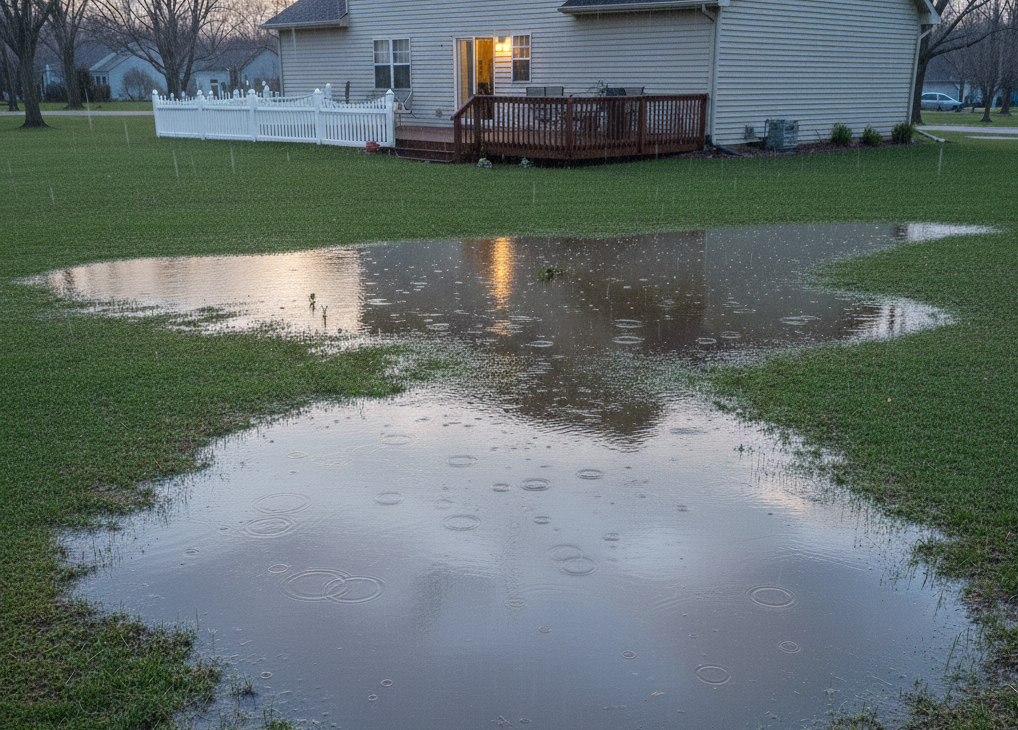
That puddle in your backyard isn’t going anywhere on its own. If you’ve watched the same spot flood after every rain—sometimes taking days to dry out—you’re dealing with a drainage problem that requires actual intervention.
Standing water in Lincoln yards is incredibly common, and the reason comes down to geology. Most of Lincoln sits on heavy clay soil that absorbs water slowly, if at all. When rain falls faster than the ground can absorb, water pools. Add flat terrain and aging drainage infrastructure in older neighborhoods, and you’ve got a recipe for persistent wet spots.
The good news: drainage solutions exist for every situation and budget. The key is matching the right fix to your specific problem.
Why Standing Water Is a Problem Worth Solving
Before spending money on drainage solutions in Lincoln, NE, it’s worth understanding what standing water actually does to your property. This isn’t just an aesthetic issue.
Lawn and Plant Damage
Grass roots need oxygen. When soil stays saturated, roots suffocate and die. You’ll notice the grass in wet areas turning yellow, thinning out, and eventually giving way to moss, algae, or bare mud. Most common lawn grasses—Kentucky bluegrass, tall fescue, perennial ryegrass—can’t tolerate waterlogged conditions for more than a few days.
Ornamental plants suffer too. Root rot from excess moisture kills more landscape plants in Lincoln than drought does. That expensive hydrangea or Japanese maple sitting in a low spot? It’s slowly drowning.
Mosquito Breeding
Standing water that persists for more than a week becomes a mosquito nursery. Female mosquitoes lay eggs in stagnant water, and the larvae mature in as little as 7-10 days during warm weather. That puddle in your backyard isn’t just annoying—it’s actively producing the mosquitoes biting you on the patio.
Lincoln’s mosquito season runs roughly May through September, which overlaps perfectly with the months you’d actually want to use your yard.
Foundation Damage
Water pooling near your house is the most serious concern. When soil against your foundation stays saturated, hydrostatic pressure builds against the basement walls. Over time, this pressure causes cracks, leaks, and structural movement.
Lincoln homes built before the 1980s often have older waterproofing that’s degraded or was inadequate to begin with. Even newer homes can develop foundation problems if the grading settles and directs water toward the house instead of away from it.
The average foundation repair in Nebraska runs $4,000 to $12,000, depending on the extent of damage. Drainage fixes that prevent this damage are a fraction of that cost.
Unusable Outdoor Space
Your landscape is a part of your home, and you should be able to enjoy it. But a soggy yard is a yard you can’t use. Kids can’t play in the mud pit. You can’t set up lawn furniture in an area that stays wet for days. The firepit gathering spot becomes inaccessible every time it rains. Standing water effectively shrinks your usable property.
Identifying Why Your Yard Has Standing Water
Not all standing water problems have the same cause, and the solution depends on correctly diagnosing what’s happening. Here are the most common culprits in Lincoln yards.
Poor Grading
The ground around your home should slope away from the foundation at a rate of at least 6 inches over the first 10 feet. Many Lincoln properties—especially in older neighborhoods like Near South, Witherbee, and Country Club—have experienced settling that reversed this slope. Water now flows toward the house instead of away from it.
You can check your grading with a simple test: place a 10-foot board against your foundation and put a level on it. The end away from the house should be noticeably higher than the end against the foundation. If it’s level or sloping toward the house, you’ve identified at least part of your problem.
Clay Soil Compaction
Lincoln’s clay soil compacts easily, especially in high-traffic areas. Compacted clay is nearly impermeable—water sits on top rather than soaking in. Common compaction zones include paths where people walk regularly, areas under swing sets or trampolines, and anywhere heavy equipment was used during construction.
You can test for compaction by pushing a screwdriver into the soil. If it won’t penetrate more than an inch or two without significant force, the soil is compacted.
High Water Table
Some areas of Lincoln have seasonally high water tables, particularly in low-lying neighborhoods near Salt Creek, Antelope Creek, and their tributaries. During wet springs, the water table can rise to within a foot or two of the surface, leaving nowhere for surface water to drain.
If your basement has water seeping up through the floor (rather than through the walls), a high water table is likely the cause. This is a different problem than surface drainage and requires different solutions.
Hardscape Runoff
Driveways, patios, sidewalks, and roofs all shed water that has to go somewhere. If your neighbor’s driveway drains onto your property, or your own patio directs water toward a low spot in the lawn, you’re dealing with concentrated runoff that overwhelms the soil’s ability to absorb it.
Lincoln’s building codes require that properties manage their own stormwater without directing it onto neighboring land, but enforcement is complaint-driven and many older configurations predate current regulations.
Buried Debris
During construction, builders sometimes bury stumps, concrete chunks, lumber, and other debris rather than hauling it away. This debris creates an underground barrier that blocks water movement. The soil above it stays saturated while water can’t reach the deeper layers where it would normally drain.
Buried debris is hard to diagnose without excavation, but suspect it if you have a wet spot that doesn’t correspond to visible grading issues and sits in an area that was developed or renovated within the past few decades.
Drainage Solutions for Lincoln Yards
Once you understand what’s causing standing water in your yard, you can choose the appropriate fix. Here are the most effective drainage solutions for Lincoln, NE properties, from simplest to most involved.
Grading and Resloping
If poor grading is sending water toward your foundation or into low spots, regrading may be all you need. This involves adding soil to create proper slope away from structures and toward appropriate drainage paths.
For foundation grading, the goal is 6 inches of drop over 10 feet, using clay-based fill soil that sheds water rather than absorbing it. The cost runs $500 to $3,000 depending on how much area needs work and whether landscaping has to be removed and replaced.
Yard regrading to eliminate low spots is more involved because you’re moving larger quantities of soil and may need to create new drainage paths to the street or storm system. Budget $1,000 to $5,000 for typical residential projects.
Timing matters: grading work is best done in early spring or fall when soil is workable but not saturated. Avoid regrading when the ground is frozen or during the soggy weeks of late March and April.
Downspout Extensions and Redirects
A surprising amount of standing water comes from your own roof. A 1,500 square foot roof sheds about 900 gallons of water during a 1-inch rain. If that water dumps right next to your foundation through short downspouts, it’s no wonder you have wet spots.
Extending downspouts to discharge at least 6 feet from the foundation—preferably 10 feet—is one of the cheapest and most effective drainage solutions available. Basic above-ground extensions cost $10-30 per downspout and take minutes to install.
For a cleaner look, buried downspout drains run the water underground through solid PVC pipe to a pop-up emitter in the lawn or a connection to the storm sewer. This costs $200-500 per downspout professionally installed.
French Drains
A french drain is a gravel-filled trench with a perforated pipe that intercepts subsurface water and carries it to a discharge point. This is the go-to solution for yards where water seeps up from below rather than pooling on the surface.
French drains work well along foundations, at the base of slopes, and around the perimeter of wet areas. They need a minimum 1% slope (1 inch of drop per 8 feet) to function properly.
Cost in Lincoln runs $25-50 per linear foot installed, so a 50-foot drain costs $1,250-2,500. Foundation perimeter drains that require deeper excavation run $4,000-8,000 for a typical home.
Materials matter: insist on rigid PVC or HDPE pipe rather than cheap corrugated tubing, and make sure the installer wraps the gravel bed in landscape fabric to keep Lincoln’s fine clay particles from clogging the system.
Channel Drains
Where water flows across a hard surface—the bottom of a sloped driveway, along the edge of a patio, at the threshold of a garage—a channel drain collects it in a narrow surface-mounted trough and directs it to a discharge point.
Channel drains are visible, which some homeowners consider a drawback. But they’re highly effective for managing concentrated surface flow that would otherwise flood specific areas.
Expect to pay $50-150 per linear foot installed, including the necessary underground piping to the discharge point. A typical driveway installation runs $800-2,000.
Dry Wells
A dry well is a buried chamber—either a perforated plastic container or a pit filled with gravel—that collects water and allows it to slowly percolate into the surrounding soil. Dry wells work best when you need to handle roof runoff or other concentrated water sources but don’t have a good gravity path to the street or storm sewer.
Dry wells are most effective in areas where the soil below Lincoln’s clay layer drains better. If you dig down 3-4 feet and hit sand or gravel, a dry well can work. If it’s clay all the way down, the well just becomes an underground puddle.
Sizing matters: a dry well needs to hold the volume of water from a typical storm while it slowly drains. A standard residential dry well (50-75 gallon capacity) handles about 500 square feet of roof area. Larger collection areas need bigger or multiple wells.
Installation costs $500-1,500 per dry well depending on size and digging conditions.
Catch Basins and Storm Drain Connections
A catch basin is a surface grate that collects water and directs it into an underground pipe. This pipe typically runs to the city storm sewer, a dry well, or a lower area of the property.
Catch basins solve surface water problems—puddles in low spots, water pooling on patios—rather than subsurface seepage. They’re often combined with french drains or channel drains in systems that handle both surface and subsurface water.
Connecting to Lincoln’s storm sewer system requires working with Lincoln Transportation and Utilities. Not all properties have accessible storm sewer connections, and some connections require permits. Your property’s elevation relative to the storm sewer also matters—you can’t drain uphill without a pump.
A catch basin with underground piping to a discharge point costs $300-800 per basin installed. Add permit fees and potentially plumber charges if connecting to the municipal system.
Sump Pump Systems
When gravity won’t move water where it needs to go, a sump pump does the job mechanically. A sump pump sits in a collection basin (the sump) and pumps water through a discharge line when the water level rises.
Interior sump pumps are common in Lincoln basements, handling water that seeps through foundation walls or up through the floor. Exterior sump pumps can solve yard drainage problems when the property is too flat for gravity drains.
Sump pumps require electricity and periodic maintenance. They’re also useless during power outages unless you have a battery backup—something worth considering given Nebraska’s storm frequency.
A residential sump pump system costs $500-1,500 for the pump and basin. Add $500-2,000 for the discharge line installation, depending on length and complexity. Battery backup systems add $300-800.
Rain Gardens
A rain garden turns a drainage problem into a landscape feature. It’s a shallow depression planted with native species that tolerate both wet and dry conditions. Water flows into the garden, pools temporarily, and slowly infiltrates into the soil.
Rain gardens work best for managing runoff from small areas—a single downspout, a patio, a section of driveway. They’re not practical for major drainage problems or areas with very high water tables.
The Lancaster County Extension Office and City of Lincoln both have resources for designing rain gardens for Lincoln’s climate (Zone 5b) and soil conditions. Native plants like switchgrass, blue flag iris, cardinal flower, and swamp milkweed thrive in the wet-dry cycle of a rain garden.
A professionally installed rain garden costs $3-15 per square foot depending on size and plant selection. A 150 square foot garden handling one downspout runs $500-2,000.
Aeration and Soil Amendment
For compacted clay soil that won’t absorb water, improving the soil itself can help. Core aeration removes plugs of soil, creating channels for water and air to penetrate. Topdressing with compost or sand after aeration improves soil structure over time.
This isn’t a quick fix—meaningful soil improvement takes years of consistent treatment. But for mild drainage problems in lawn areas, annual aeration combined with organic matter addition gradually increases the soil’s infiltration rate.
Core aeration costs $75-200 for a typical Lincoln lawn when done professionally. Most homeowners rent an aerator for $50-100 per day and do it themselves.
What Drainage Solutions Cost in Lincoln, NE
Here’s a summary of typical costs for the most common drainage solutions in Lincoln:
Basic fixes (DIY-friendly)
- Downspout extensions: $10-30 each
- Core aeration: $75-200 (professional) or $50-100 (rental)
- Small grading corrections: $500-1,500
Moderate projects
- Buried downspout drains: $200-500 per downspout
- Dry wells: $500-1,500 each
- French drains: $25-50 per linear foot ($1,250-2,500 for 50 feet)
- Catch basins: $300-800 each
- Rain gardens: $500-2,000 for typical residential size
Major drainage systems
- Channel drains: $800-2,000 per installation
- Yard regrading: $1,000-5,000
- Foundation perimeter drains: $4,000-8,000
- Interior basement drains with sump pump: $3,000-6,000
Most Lincoln homes with standing water problems can be fixed for $1,500-5,000. Complex situations involving foundation protection, multiple problem areas, or sump pump systems run higher.
When to Call a Professional
Some drainage work is straightforward enough for handy homeowners. Extending downspouts, installing a simple french drain in an accessible area, or building a small rain garden are reasonable DIY projects.
Call a professional when:
The problem involves your foundation. The stakes are too high for trial and error. A failed DIY fix means continued water intrusion and potential structural damage.
You need to connect to the city storm sewer. This typically requires permits and sometimes a licensed plumber for the actual connection.
The drainage system involves multiple components. Designing a system with proper slopes, adequate capacity, and appropriate discharge points requires experience that DIYers rarely have.
Access is difficult. If solving the problem requires equipment you don’t own or excavation in tight spaces, professional crews work faster and safer.
The cause isn’t obvious. If you’re not sure why water collects where it does, a professional assessment prevents you from installing the wrong solution.
Choosing a Drainage Contractor in Lincoln
Not all landscaping companies handle drainage work, and not all drainage contractors do it well. Here’s how to find the right one.
Questions to Ask
What’s causing my drainage problem? A good contractor diagnoses before prescribing. Be skeptical of anyone who quotes a solution before assessing the situation.
Where will the water go? Every drainage system needs a discharge point. The contractor should explain specifically where your water will end up and confirm that discharge point can handle the volume.
What materials will you use? Ask about pipe type (rigid PVC or HDPE is better than corrugated), gravel specification, and fabric use. Details matter for longevity.
Do you handle permits if needed? Storm sewer connections and some excavation work require permits in Lincoln. The contractor should know the requirements and include permit costs in the quote.
Can you provide references for similar projects? Ask for contacts from recent drainage jobs, not just general landscaping clients.
Red Flags
Quotes without site visits. Anyone who prices drainage work from a phone description is guessing.
Solutions that send water onto neighboring property. This creates legal liability and neighborhood conflict.
Unusually low bids. Drainage work has real material and labor costs. A quote significantly below others usually means cut corners.
Pressure to decide immediately. Legitimate contractors don’t need you to sign today.
Seasonal Timing for Drainage Work in Lincoln
Spring (March-May): The soggy season reveals exactly where your problems are, making it a good time for assessment. However, saturated soil is difficult to work with, and disturbed areas need time to stabilize before summer heat. Late spring (May) is often ideal for installation.
Summer (June-August): Dry conditions make excavation easier, but crews and equipment are in high demand for other landscaping work. Plan ahead if you want summer installation. Watering newly seeded areas over a drainage trench is essential during hot weather.
Fall (September-October): Excellent conditions for drainage work. Moderate temperatures, workable soil, and enough time for grass to establish before winter. This is when many Lincoln contractors have the most availability.
Winter (November-February): Frozen ground makes excavation difficult or impossible. Emergency drainage repairs can happen, but planned work should wait for spring.
Taking Action on Standing Water
Every spring, Lincoln yards flood. By May, homeowners are searching for solutions. By June, contractors are booked out for weeks. By the time schedules open up, the problem seems less urgent—until next spring, when the cycle repeats.
If you have standing water in your yard, the best time to address it was before it became a pattern. The second best time is now, while you’re thinking about it.
Start by observing where water collects and how long it takes to drain. Note whether the problem is surface water pooling in low spots or subsurface water seeping up from below. Check your grading around the foundation. Look at where your downspouts discharge.
With that information, you can have a productive conversation with a drainage contractor—or decide which DIY solution to tackle yourself.
Standing water problems don’t fix themselves. But with the right diagnosis and appropriate solution, they do get fixed, often for less money and effort than homeowners expect.
Priority Lawn and Landscape provides drainage solutions, grading, and full-service landscaping for residential and commercial properties throughout Lincoln, NE, and Lancaster County. Contact us for a drainage assessment.
EXCELLENT Based on 26 reviews
 Posted on Google
 Kelsey SlausonPosted on Google
 Amy JensenThank you Priority Lawn for taking care of my yard! I had lots of weeds and unwanted plants growing throughout my yard. I had contacted a few other places and found that they only spray weeds and do not dig them up. What a disappointment! Not only did Priority Lawn take care of them all they did a fantastic job!Posted on Google
 RyanPriority did a great job. Would recommend to anyonePosted on Google
 David MattinglyBryce was awesome from the design meeting throughout the project. Very professional and a great job on my new grill area on THANKSPosted on Google
 Barbara AndersonPosted on Google
 Alex SwiatekPosted on Google
 Diane HudsonExcellent, quality work. Very professional, knowledgeable, and skilled.! Excited to work with this company in the future!Posted on Google
 Tahner PHuge shoutout to Bryce and the whole Priority team who came out last week. Bryce was super helpful in figuring out the drainage issue we had going on and really gave us a good idea of what to expect and how it could be fixed. Also the quote was incredibly reasonable compared to many others we talked to. They did a great job getting the drainage done and we are already seeing a big difference in our yard. They also were awesome getting everything cleaned up. The biggest thing was how awesome they were to my 6 year old. He was so interested with what was going on, and they let him get involved and help out. For like 4-5 hours he was out there moving dirt and "helping." Hopefully it was not too much of a bother. Anyways, thanks a ton to the Bryce and his team!Posted on Google
 Sonja KroppWe are so pleased with the results of our landscaping project. Bryce provided us with invaluable suggestions, detailed (and reasonable) pricing estimates, and a timely schedule. His crew was very professional and attentive to last minute changes. Thank you!Posted on Google
 KIM KingI am so happy with Priority One! In just a few weeks, our yard is healthy, green, and growing! Our shrubs are beautifully thriving and trimmed. I am so excited for our landscaping project to begin very soon! Great customer service, attention to detail and knowledgeable! Thank you!Verified by TrustindexTrustindex verified badge is the Universal Symbol of Trust. Only the greatest companies can get the verified badge who has a review score above 4.5, based on customer reviews over the past 12 months. Read more
About the Author
