
Spring Aeration and Overseeding in Nebraska
The Lincoln Homeowner's Guide
Spring aeration in Lincoln gives your lawn the reset it needs after a harsh Nebraska winter. The freeze-thaw cycles we experience here compact soil more aggressively than in milder climates, and our heavy clay base makes the problem worse.
If your grass struggled last summer or you’re seeing thin, patchy areas as the snow melts, aeration combined with overseeding is likely the solution.
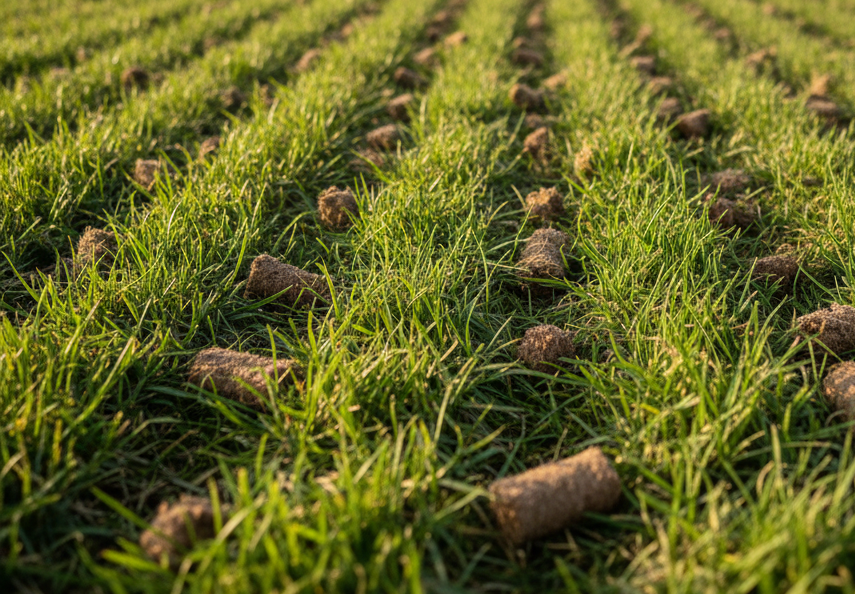
This guide covers everything Lincoln homeowners need to know about spring aeration—when to do it, what it costs, and how to get results that actually last.
Why Spring Aeration Matters for Lincoln Lawns
Lincoln sits in USDA Hardiness Zone 5b, which means we deal with temperature swings that other regions don’t face. Soil freezes, thaws, refreezes, and compacts repeatedly between November and March. By the time April arrives, that soil is often as hard as a parking lot in the top few inches.
Add in the clay-heavy soil common throughout Lancaster County, and you’ve got conditions that suffocate grass roots. Oxygen can’t penetrate. Water runs off instead of soaking in. Fertilizer sits on the surface where it either washes away or burns the grass.
Core aeration punches through that compacted layer and pulls out small plugs of soil. Those holes—typically 2 to 3 inches deep and spaced about 3 inches apart—create channels for air, water, and nutrients to reach the root zone. The plugs left on the surface break down within a couple of weeks and return organic matter to the lawn.
Signs Your Lincoln Lawn Needs Spring Aeration
Not every lawn requires annual aeration, but most Lincoln properties benefit from it at least every one to two years. Your lawn is telling you it needs aeration if water pools on the surface after rain or irrigation rather than soaking in. Thin grass that won’t thicken despite fertilizing is another clear signal. If you can push a screwdriver into your lawn and it takes real effort, you’ve got compaction. Heavy foot traffic areas—around swing sets, along sidewalks, near patios—compact faster than the rest of the yard. And if you’re fighting thatch buildup thicker than half an inch, aeration helps break it down.
Spring Aeration Lincoln: Timing It Right for Nebraska
Timing matters more than most homeowners realize. Aerate too early and you’ll damage grass that hasn’t fully broken dormancy. Wait too long and you’ll stress the lawn heading into summer heat.
For Lincoln and the surrounding areas, the ideal window for spring aeration runs from mid-April through mid-May. The key indicator isn’t the calendar—it’s soil temperature. Once soil temps at a 4-inch depth consistently reach 55°F, cool-season grasses like Kentucky bluegrass, tall fescue, and perennial ryegrass are actively growing and can recover quickly from aeration.
Most years, that temperature threshold arrives in Lincoln around the third week of April. You can check current soil temperatures through the Nebraska State Climate Office or by using a simple soil thermometer.
Weather Conditions for Successful Aeration
Soil moisture affects aeration quality significantly. The ground should be moist but not waterlogged—similar to how it feels a day or two after a good soaking rain. Dry, hard soil resists the aerator tines and produces shallow, ineffective holes. Saturated soil turns into a muddy mess and the plugs won’t separate cleanly.
If it hasn’t rained recently, water your lawn thoroughly about 24 to 48 hours before your scheduled aeration. One inch of irrigation is usually enough to get the soil to the right consistency.
Types of Aeration Available in Lincoln
You’ll encounter two main approaches when shopping for aeration services: core aeration and spike aeration. The difference matters for results.
Core Aeration (Plug Aeration)
Core aerators use hollow tines to extract actual plugs of soil from the lawn. These plugs, usually about the diameter of a finger and 2 to 3 inches long, are deposited on the surface where they break down naturally. This is the gold standard for addressing compaction in Lincoln’s clay soils because it physically removes material and creates genuine space for roots to expand.
Professional core aerators are heavy-duty machines that make multiple passes over the lawn. The result is a dense pattern of holes that provides maximum benefit.
Spike Aeration
Spike aerators poke holes in the ground without removing soil. While cheaper and easier, spike aeration actually compresses the soil around each hole, which can make compaction worse over time. For Lincoln’s clay soil conditions, spike aeration is generally not recommended as a standalone treatment. It can provide some short-term benefit for water penetration but won’t address the underlying compaction issue.
Why Combine Overseeding with Spring Aeration
Aeration creates the perfect conditions for new grass seed to establish. Those freshly pulled cores leave behind holes that act as tiny seed beds—protected from birds, making good soil contact, and staying consistently moist. When you spread seed immediately after aeration, germination rates improve dramatically compared to broadcasting seed on undisturbed turf.
For Lincoln lawns, overseeding during spring aeration makes sense when you’re dealing with thin or bare patches, when you want to introduce more drought-tolerant or disease-resistant grass varieties, when you’re transitioning from an older lawn to improved cultivars, or when winter damage has left gaps in your turf.
Best Grass Seed for Lincoln, Nebraska
Lincoln’s climate calls for cool-season grasses that can handle both summer heat and winter cold. The most successful options for Zone 5b include tall fescue, which offers excellent heat and drought tolerance once established and works well in both sun and partial shade. Kentucky bluegrass is the classic choice for Lincoln lawns, providing a dense, self-repairing turf that handles foot traffic. Perennial ryegrass germinates quickly and is often mixed with other grasses for fast coverage. Fine fescues work well in shaded areas where other grasses struggle.
A blend of two or three grass types typically performs better than a single variety because different grasses respond differently to stresses like disease, drought, and temperature extremes.
Seeding Rates for Nebraska Overseeding
For overseeding existing turf after aeration, apply Kentucky bluegrass at 2 to 3 pounds per 1,000 square feet. Tall fescue should be applied at 4 to 6 pounds per 1,000 square feet. Perennial ryegrass works best at 4 to 5 pounds per 1,000 square feet. Fine fescue blends should be applied at 3 to 4 pounds per 1,000 square feet. These rates are roughly half of what you’d use for establishing a new lawn from scratch.
Spring Aeration Costs in Lincoln, NE
What you’ll pay for professional aeration in Lincoln depends on your lawn size and whether you’re adding overseeding to the service.
Professional Aeration Pricing
Core aeration alone typically runs $75 to $150 for lawns up to 5,000 square feet in the Lincoln area. Larger properties of 5,000 to 10,000 square feet usually fall in the $125 to $200 range. For properties over 10,000 square feet, expect to pay $175 to $300 or more, depending on accessibility and terrain.
When you add overseeding to aeration, the combined service typically costs $150 to $300 for smaller lawns and $250 to $450 for larger properties. This includes the seed cost and application.
DIY Aeration Costs
Renting a core aerator from local equipment rental shops in Lincoln runs about $60 to $100 for a half-day rental. These machines are heavy—often 200 to 300 pounds—and require a truck or trailer for transport. You’ll also need the physical stamina to wrestle the machine across your lawn for an hour or more.
For most homeowners, professional aeration is worth the cost. The equipment is commercial-grade, the work gets done quickly, and you avoid the hassle of transport and operation. Unless you have a very large property or enjoy equipment-intensive yard work, hiring a professional typically makes more sense.
The Aeration and Overseeding Process
Understanding what happens during professional aeration helps you prepare your lawn and know what to expect.
Before Aeration
About a week before your scheduled service, mow your lawn slightly shorter than usual—around 2 to 2.5 inches instead of the typical 3 to 3.5 inches. This helps the aerator tines penetrate more effectively and allows better seed-to-soil contact if you’re overseeding.
Mark any irrigation heads, invisible fence wires, or shallow utility lines with flags. Most lawn care companies will request this, but it’s worth double-checking. Aerator tines can damage these systems if they’re not avoided.
Water your lawn 24 to 48 hours ahead if rain hasn’t done the job. The soil should be moist to a depth of about 4 inches.
During Aeration
Professional crews typically make two passes over the lawn in different directions—north-south and then east-west. This cross-pattern creates more holes and more even coverage than a single pass.
For the typical 5,000-square-foot Lincoln lawn, aeration takes about 30 to 45 minutes. Larger properties or those with obstacles require more time. After aeration, if overseeding is included, seed is broadcast using a spreader and may be followed by a light raking or dragging to work the seed into the aeration holes.
After Aeration
The soil plugs scattered across your lawn might look messy, but resist the urge to rake them up. They break down within 2 to 3 weeks, returning nutrients and organic matter to the soil. Foot traffic and mowing help speed the process.
If you’ve overseeded, watering becomes critical for the next few weeks. New grass seed needs consistent moisture to germinate—typically light watering once or twice daily for the first 2 to 3 weeks, then gradually transitioning to deeper, less frequent watering as seedlings establish.
Hold off on mowing until new grass reaches about 3 inches tall. This usually takes 3 to 4 weeks after seeding, depending on temperature and moisture conditions.
Spring vs. Fall Aeration in Nebraska
You’ll sometimes hear that fall is the only time to aerate cool-season lawns. That advice doesn’t account for Lincoln’s specific conditions.
Fall aeration (September through mid-October) remains an excellent choice. Grass is entering a period of active root growth, and cooler temperatures reduce stress. Overseeding in fall gives new grass an entire growing season to establish before facing summer heat.
Spring aeration in Lincoln makes sense when winter damage has been severe, when you need to address compaction before summer’s demands, when spring is your only available window, or when combined with spring overseeding for lawns that need thickening before summer.
For lawns with significant compaction, aerating both spring and fall delivers the best results. Annual aeration is appropriate for high-traffic properties, sports fields, or lawns on heavy clay soil. Lighter-use lawns on better soil may only need aeration every 2 to 3 years.
Common Spring Aeration Mistakes to Avoid
A few missteps can undermine your aeration results or even damage your lawn.
Aerating too early is one of the most common errors. If you aerate before the grass has broken dormancy and begun active growth, recovery will be slow and weeds may colonize the holes before grass does. Wait until you’ve mowed at least twice and the lawn is clearly growing.
Aerating dry, hard soil produces shallow holes that don’t address compaction in the root zone. If the aerator is bouncing off the surface rather than sinking in, the soil is too dry.
Applying weed killer before or immediately after overseeding defeats the purpose. Pre-emergent herbicides prevent grass seed from germinating along with weeds. If you’re overseeding, skip spring pre-emergent or use a product specifically labeled as safe for seeding.
Neglecting watering after overseeding kills germinating seed. New grass is vulnerable for the first few weeks and needs consistent moisture.
Mowing too soon after overseeding can tear out young seedlings before they’re anchored. Wait until new grass is at least 3 inches tall before the first mow.
Frequently Asked Questions About Spring Aeration in Lincoln
Should I pick up the plugs after aeration?
No. Leave them on the lawn. They break down within a couple of weeks and add organic matter back to the soil. Removing them eliminates this benefit and adds unnecessary work.
Can I aerate if I applied pre-emergent this spring?
You can aerate, but you shouldn’t overseed. Pre-emergent herbicides create a barrier that prevents weed seeds from germinating—but they also stop grass seed. If you’ve applied pre-emergent and want to overseed, wait until fall.
How soon after aeration can I fertilize?
Immediately. In fact, fertilizing right after aeration is ideal because the nutrients can reach the root zone through the holes. If you’ve overseeded, use a starter fertilizer that’s appropriate for new grass.
Will aeration help with standing water in my yard?
Aeration improves water infiltration through compacted soil, which can reduce surface pooling. However, if standing water is caused by grading issues or poor drainage infrastructure, aeration alone won’t solve the problem. You may need drainage solutions like French drains or regrading.
My lawn has lots of tree roots. Can it still be aerated?
Yes, but the aerator will bounce over shallow roots without penetrating. This is normal and expected. The areas between roots will still benefit from aeration. Be aware that repeatedly aerating very close to trees can damage feeder roots over time, so don’t make extra passes in those areas.
How long does it take to see results from aeration and overseeding?
You’ll notice the plugs disappearing within 2 to 3 weeks. Overseeded grass typically germinates in 7 to 21 days depending on the variety—perennial ryegrass is fastest, Kentucky bluegrass is slowest. The full benefit of improved root growth and turf density usually becomes apparent over the following 6 to 8 weeks.
Get Professional Spring Aeration in Lincoln
Spring aeration in Lincoln is one of the most effective things you can do for your lawn—especially after a tough Nebraska winter. Combined with overseeding, it addresses compaction, fills in thin spots, and sets your grass up for a stronger growing season.
Priority Lawn and Landscape provides professional core aeration and overseeding services throughout Lincoln and Lancaster County. Our commercial-grade equipment and experienced crews get the job done right, so you don’t have to wrestle with a rental aerator or wonder if you’re timing it correctly.
Contact us to schedule your spring aeration or request a free quote. We’ll assess your lawn’s specific needs and recommend the right approach for your property.
EXCELLENT Based on 26 reviews
 Posted on Google
 Kelsey SlausonPosted on Google
 Amy JensenThank you Priority Lawn for taking care of my yard! I had lots of weeds and unwanted plants growing throughout my yard. I had contacted a few other places and found that they only spray weeds and do not dig them up. What a disappointment! Not only did Priority Lawn take care of them all they did a fantastic job!Posted on Google
 RyanPriority did a great job. Would recommend to anyonePosted on Google
 David MattinglyBryce was awesome from the design meeting throughout the project. Very professional and a great job on my new grill area on THANKSPosted on Google
 Barbara AndersonPosted on Google
 Alex SwiatekPosted on Google
 Diane HudsonExcellent, quality work. Very professional, knowledgeable, and skilled.! Excited to work with this company in the future!Posted on Google
 Tahner PHuge shoutout to Bryce and the whole Priority team who came out last week. Bryce was super helpful in figuring out the drainage issue we had going on and really gave us a good idea of what to expect and how it could be fixed. Also the quote was incredibly reasonable compared to many others we talked to. They did a great job getting the drainage done and we are already seeing a big difference in our yard. They also were awesome getting everything cleaned up. The biggest thing was how awesome they were to my 6 year old. He was so interested with what was going on, and they let him get involved and help out. For like 4-5 hours he was out there moving dirt and "helping." Hopefully it was not too much of a bother. Anyways, thanks a ton to the Bryce and his team!Posted on Google
 Sonja KroppWe are so pleased with the results of our landscaping project. Bryce provided us with invaluable suggestions, detailed (and reasonable) pricing estimates, and a timely schedule. His crew was very professional and attentive to last minute changes. Thank you!Posted on Google
 KIM KingI am so happy with Priority One! In just a few weeks, our yard is healthy, green, and growing! Our shrubs are beautifully thriving and trimmed. I am so excited for our landscaping project to begin very soon! Great customer service, attention to detail and knowledgeable! Thank you!Verified by TrustindexTrustindex verified badge is the Universal Symbol of Trust. Only the greatest companies can get the verified badge who has a review score above 4.5, based on customer reviews over the past 12 months. Read more
About the Author
