
French Drain Installation in Lincoln, NE: Solving Yard Drainage Problems
Standing water in your yard isn’t just annoying—it’s killing your grass, threatening your foundation, and turning your property into a mosquito breeding ground. If you’ve noticed puddles that stick around for days after rain or a perpetually soggy section of lawn, you’re dealing with a drainage problem that won’t fix itself.
Lincoln’s clay-heavy soil is notorious for poor drainage. Water doesn’t percolate through it the way it does through sandy or loamy soil.
Instead, it sits on the surface or moves toward the lowest point on your property—often your foundation, basement, or that corner of the yard where nothing grows.
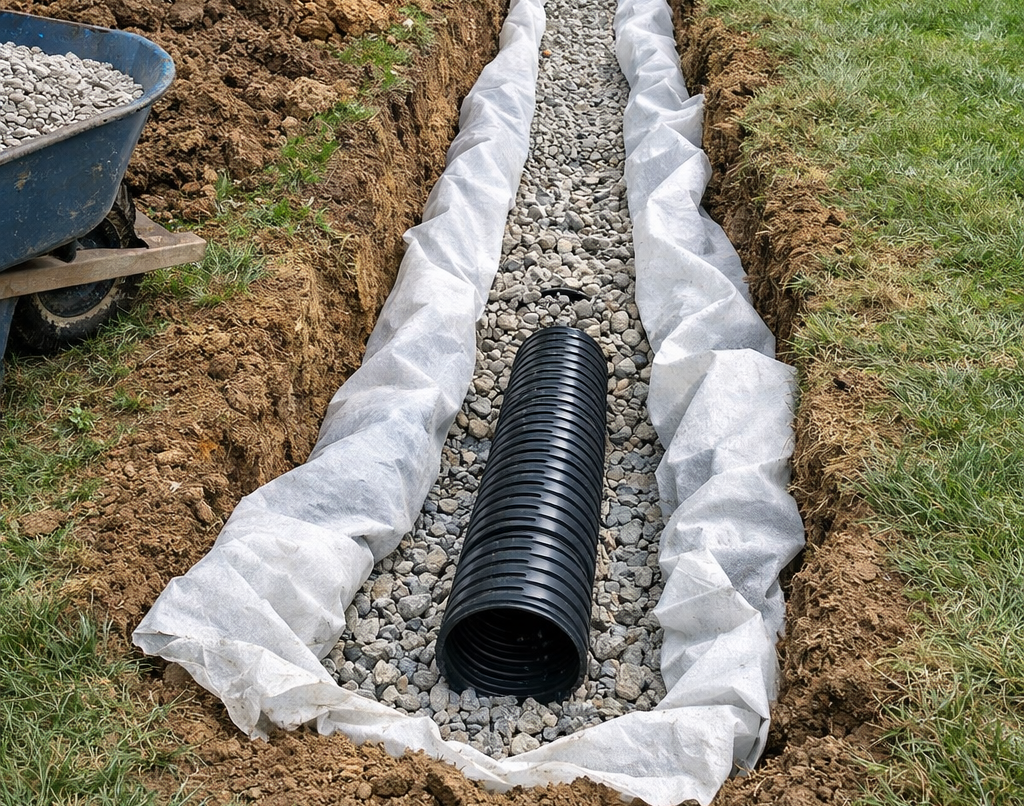
A french drain is one of the most effective solutions for yard drainage in Lincoln, Nebraska. Here’s what you need to know before you start digging.
What Is a French Drain and How Does It Work?
A french drain is a gravel-filled trench containing a perforated pipe that redirects water away from problem areas. The concept is simple: water follows the path of least resistance. When groundwater or surface water encounters the gravel-filled trench, it flows into the perforated pipe and gets carried to a discharge point—typically a storm drain, dry well, or lower area of your property.
The system works through gravity, so proper slope is critical. A french drain needs at least a 1% grade (1 inch of drop per 8 feet of length) to move water effectively. In flat yards, this sometimes means digging deeper as you go or getting creative with discharge locations.
Despite the name, french drains have nothing to do with France. They’re named after Henry French, a Massachusetts farmer who popularized the technique in his 1859 book on farm drainage.
Signs You Need a French Drain in Lincoln, NE
Not every wet spot requires a french drain. Sometimes the fix is as simple as extending a downspout or regrading a small section of lawn. But certain symptoms point toward a more serious drainage issue that a french drain can solve.
Water Pooling After Rain
If water collects in the same spots every time it rains and takes more than 24 hours to drain, you’ve got a problem. Lincoln averages about 30 inches of precipitation annually, with the heaviest rainfall from April through June. That’s a lot of water your yard needs to handle, and if it’s not draining properly, it’s going somewhere—usually somewhere you don’t want it.
Soggy or Spongy Lawn Areas
Some sections of your yard might feel soft underfoot even when it hasn’t rained recently. This indicates that water is collecting beneath the surface and has nowhere to go. These areas often develop moss, algae, or fungal growth because of the constant moisture.
Water in Your Basement or Crawl Space
This is the big one. If you’re getting water intrusion in your basement, especially along the walls or floor seams, surface water is likely migrating toward your foundation. A french drain installed around the perimeter of your home—called a footing drain or curtain drain—can intercept this water before it reaches your foundation walls.
Erosion Along Your Foundation
Noticing soil washing away from the base of your house? That erosion is carrying your landscaping into the street while also exposing your foundation to moisture problems. The soil around Lincoln homes often settles over time, creating negative grading that directs water toward the house instead of away from it.
Retaining Wall Failures
If you have a retaining wall that’s leaning, cracking, or showing water stains, hydrostatic pressure from trapped water is likely the culprit. Retaining walls in Lincoln should always include drainage provisions, and a french drain behind the wall is standard practice.
French Drain Installation Process
Installing a french drain isn’t complicated in concept, but the execution requires attention to detail. Here’s what the process involves.
Planning and Layout
Before any digging happens, you need to identify the water source, map the drain path, and determine the discharge location. In Lincoln, you’ll also need to call 811 to have underground utilities marked—this is legally required and prevents you from hitting gas lines, electrical cables, or fiber optic lines.
The drain path should follow the natural low points of your yard where water already wants to flow. Fighting topography makes the job harder and the drain less effective.
Excavation
French drains typically require a trench 6 to 12 inches wide and 18 to 24 inches deep. For a drain protecting your foundation, you might need to go deeper—sometimes 4 to 6 feet to reach below the footer.
Lincoln’s clay soil makes digging challenging. It’s dense, sticky when wet, and hard as concrete when dry. Most residential french drains require moving several cubic yards of soil, which is backbreaking work with a shovel. Many homeowners rent a trencher for larger projects.
Installing the Drain Components
A proper french drain includes several layers:
The trench bottom gets lined with landscape fabric to prevent soil from migrating into the gravel. Some installers skip this step, but in Lincoln’s clay soil, it’s important for long-term performance.
A 2-3 inch base layer of washed gravel (typically 3/4-inch stone) goes down first. The perforated pipe sits on top of this base, with the holes facing down—this is counterintuitive, but it works better because water rises into the pipe from below.
More gravel fills the trench around and over the pipe, leaving about 4-6 inches of space at the top. The landscape fabric wraps over the gravel, and then topsoil covers the final layer. You can seed grass over the drain, and within a few months, you won’t see any evidence of the trench.
Discharge Point Options
The water has to go somewhere. In Lincoln, your options include:
Connecting to the city storm sewer system, if one is accessible and your property’s elevation allows for it. You’ll need to check with Lincoln Transportation and Utilities about connection requirements.
A pop-up emitter in a lower area of your yard, which releases water at the surface when the drain is flowing. This works well if you have a natural drainage path to the street or an adjacent property (with appropriate drainage easements).
A dry well, which is essentially a large buried container filled with gravel that allows water to slowly percolate into the surrounding soil. Dry wells work best in areas with better-draining subsoil below the clay layer.
French Drain Cost in Lincoln, Nebraska
Pricing varies significantly based on length, depth, and site conditions. Here’s what Lincoln homeowners typically pay for professional french drain installation:
A basic linear french drain runs $25 to $50 per linear foot installed. A 50-foot drain to address a soggy backyard corner would cost $1,250 to $2,500.
Foundation perimeter drains are more expensive because of the depth required and the need to work around landscaping, utilities, and HVAC equipment. Expect $4,000 to $8,000 for a typical Lincoln home.
Interior french drains (installed inside the basement) run $3,000 to $6,000 depending on basement size and whether a sump pump is included.
Several factors push costs higher:
Difficult access that prevents machine use adds labor costs. If everything has to be dug by hand because your backyard is only accessible through a gate, budget accordingly.
Deep digs for foundation drains in homes with basements cost more than shallow surface drains.
Rock or hardpan beneath the clay layer slows excavation significantly.
Connecting to the city storm system requires permits and sometimes a plumber for the actual connection.
DIY vs. Professional French Drain Installation
A french drain is one of the more DIY-friendly drainage solutions, assuming you’re comfortable with significant physical labor and have the right tools. The materials are straightforward and available at any building supply store.
When DIY Makes Sense
Short runs under 30 feet in accessible areas are manageable weekend projects. If you’re addressing a wet corner of the yard and can discharge to a lower area via pop-up emitter, you might save $1,000 or more by doing it yourself.
When to Hire a Professional
Foundation drains should almost always be professionally installed. The stakes are higher (basement flooding causes expensive damage), the depths are greater, and proper waterproofing of the foundation wall is often part of the project.
Complex drainage systems involving multiple drains, catch basins, and connections to municipal infrastructure also warrant professional installation. Getting the slopes right on a branching system is tricky, and mistakes mean water backs up instead of draining.
Properties with extensive utility runs benefit from professional installation because experienced crews know how to work around obstacles without damaging underground lines.
Common French Drain Mistakes
Improper installation leads to french drains that don’t work or fail prematurely. These are the most common errors we see in Lincoln.
Insufficient Slope
Water doesn’t flow uphill. If your drain doesn’t maintain consistent downward slope to the discharge point, water pools in the pipe and defeats the purpose. Laser levels and careful measurement during installation prevent this problem.
Wrong Pipe Material
Corrugated black plastic pipe with slits (often called “Big O” pipe) is cheap and commonly used, but it crushes under soil weight and clogs easily. Rigid PVC with drilled holes or rigid HDPE corrugated pipe performs better and lasts longer.
No Filter Fabric
Without landscape fabric, Lincoln’s fine clay particles migrate into the gravel and eventually clog the system. Within a few years, your french drain becomes a buried pipe full of mud. The fabric prevents this while still allowing water through.
Sock-Wrapped Pipe in Clay Soil
Some installers wrap the perforated pipe in filter fabric (a “sock”). This works in sandy soil but actually causes problems in clay. The fine particles clog the sock material faster than they would clog bare gravel. In Lincoln, it’s better to rely on the fabric wrapped around the entire gravel bed.
Inadequate Gravel
Using round river rock instead of angular crushed gravel reduces water flow. The angular pieces don’t nest together as tightly, leaving more space for water movement. Also, too little gravel—especially below the pipe—limits the drain’s capacity.
Maintaining Your French Drain
A properly installed french drain requires minimal maintenance but isn’t completely maintenance-free.
Inspect the discharge point after heavy rains to confirm water is actually flowing out. If the drain isn’t discharging but your yard is still wet, something’s wrong.
Keep the discharge area clear of debris, leaves, and soil buildup that could block the outlet.
If your drain has clean out access points, flush the system every few years with a garden hose to clear any sediment that’s accumulated.
Watch for settling along the drain path, which indicates the gravel is compacting or soil is migrating into the trench. Top-dressing with additional soil can address minor settling.
Other Yard Drainage Solutions in Lincoln, Nebraska
French drains solve many drainage problems, but they’re not always the best or only answer. Depending on your situation, these alternatives or additions might make sense.
Surface Grading
Sometimes the simplest fix is regrading the yard to direct water away from problem areas. This works when the issue is surface water flow rather than subsurface water. Proper grading should move water at least 6 feet away from your foundation.
Channel Drains
For concentrated water flow—like where a patio meets the house or at the bottom of a sloped driveway—a channel drain collects water across a narrow line and directs it to a discharge point. Channel drains are surface-mounted and visible, unlike buried french drains.
Dry Creek Beds
A dry creek bed is essentially a decorative french drain. The gravel is exposed rather than buried, and larger river rock creates the appearance of a natural stream bed. These work well for surface water problems and add visual interest to the landscape.
Rain Gardens
If you have space in a low area of your yard, a rain garden turns a drainage problem into an attractive planting bed. Native plants that tolerate wet conditions absorb water while the amended soil allows for infiltration. Rain gardens require more space than french drains but handle water passively with no maintenance.
Sump Pump Systems
For properties where gravity drainage isn’t possible—common in Lincoln’s flatter areas—a sump pump mechanically moves water from a collection basin to a discharge point. Sump pumps require electricity and occasional maintenance but solve drainage problems that gravity alone can’t address.
Best Time to Install a French Drain in Lincoln
Timing matters for french drain installation in Lincoln’s climate.
Spring and fall are ideal. The soil is workable but not saturated, temperatures are comfortable for outdoor labor, and you can establish grass over the trench before extreme weather hits.
Summer works but is harder on crews due to heat, and dry clay soil becomes extremely difficult to dig. Irrigation before excavation can help soften the ground.
Winter installation is possible but not recommended. Frozen ground may require additional equipment, and you can’t establish grass until spring, leaving the trench vulnerable to erosion.
If you’re experiencing active flooding or water intrusion, don’t wait for perfect conditions. The damage from ongoing water problems outweighs the inconvenience of off-season installation.
Hiring a French Drain Contractor in Lincoln
If you’re hiring out the work, choosing the right contractor prevents headaches down the line. Here’s what to look for.
Questions to Ask
What type of pipe do you use? (Avoid contractors who default to the cheapest corrugated tubing.)
Do you wrap the gravel bed in landscape fabric? (The answer should be yes for Lincoln’s clay soil.)
What slope will the drain have? (They should be able to tell you the specific grade or inches of drop.)
Where will the water discharge? (A vague answer here suggests they haven’t thought through the design.)
Can you provide references for similar projects in Lincoln? (Local experience with our soil conditions matters.)
Red Flags
Quotes that seem too low probably cut corners on materials or depth.
Contractors who want to start immediately without calling 811 first are breaking the law and risking utility strikes.
Anyone who suggests just “piping water to the property line” without considering where it goes next might be creating problems for your neighbors and potentially liability for you.
Solving Yard Drainage Problems for Good
Drainage issues don’t improve with time. That soggy corner gets soggier. The puddle against your foundation gets bigger. The erosion channel cuts deeper. Addressing the problem now prevents more expensive repairs later.
A french drain installed correctly—with proper slope, appropriate materials, and a legitimate discharge point—will protect your property for decades. It’s not the flashiest landscaping investment you can make, but it might be the most important one.
If you’re dealing with yard drainage problems in Lincoln, Nebraska, contact Priority Lawn and Landscape for an assessment. We’ll identify what’s causing your water issues and recommend the most cost-effective solution, whether that’s a french drain, regrading, or another approach entirely.
Priority Lawn and Landscape provides drainage solutions, hardscaping, and full-service landscaping for residential and commercial properties throughout Lincoln, NE and Lancaster County.
EXCELLENT Based on 26 reviews
 Posted on Google
 Kelsey SlausonPosted on Google
 Amy JensenThank you Priority Lawn for taking care of my yard! I had lots of weeds and unwanted plants growing throughout my yard. I had contacted a few other places and found that they only spray weeds and do not dig them up. What a disappointment! Not only did Priority Lawn take care of them all they did a fantastic job!Posted on Google
 RyanPriority did a great job. Would recommend to anyonePosted on Google
 David MattinglyBryce was awesome from the design meeting throughout the project. Very professional and a great job on my new grill area on THANKSPosted on Google
 Barbara AndersonPosted on Google
 Alex SwiatekPosted on Google
 Diane HudsonExcellent, quality work. Very professional, knowledgeable, and skilled.! Excited to work with this company in the future!Posted on Google
 Tahner PHuge shoutout to Bryce and the whole Priority team who came out last week. Bryce was super helpful in figuring out the drainage issue we had going on and really gave us a good idea of what to expect and how it could be fixed. Also the quote was incredibly reasonable compared to many others we talked to. They did a great job getting the drainage done and we are already seeing a big difference in our yard. They also were awesome getting everything cleaned up. The biggest thing was how awesome they were to my 6 year old. He was so interested with what was going on, and they let him get involved and help out. For like 4-5 hours he was out there moving dirt and "helping." Hopefully it was not too much of a bother. Anyways, thanks a ton to the Bryce and his team!Posted on Google
 Sonja KroppWe are so pleased with the results of our landscaping project. Bryce provided us with invaluable suggestions, detailed (and reasonable) pricing estimates, and a timely schedule. His crew was very professional and attentive to last minute changes. Thank you!Posted on Google
 KIM KingI am so happy with Priority One! In just a few weeks, our yard is healthy, green, and growing! Our shrubs are beautifully thriving and trimmed. I am so excited for our landscaping project to begin very soon! Great customer service, attention to detail and knowledgeable! Thank you!Verified by TrustindexTrustindex verified badge is the Universal Symbol of Trust. Only the greatest companies can get the verified badge who has a review score above 4.5, based on customer reviews over the past 12 months. Read more
