
Retaining Wall Solutions for Lincoln Yards
When You Need One & What It Costs
If you’ve noticed soil creeping down a slope in your yard, water pooling where it shouldn’t, or a gradual shift in your landscape’s shape, you might be dealing with an erosion problem that a retaining wall can solve. For Lincoln homeowners, retaining walls aren’t just about function—they can transform an unusable hillside into terraced garden beds, create level areas for patios, and add serious curb appeal to your property.
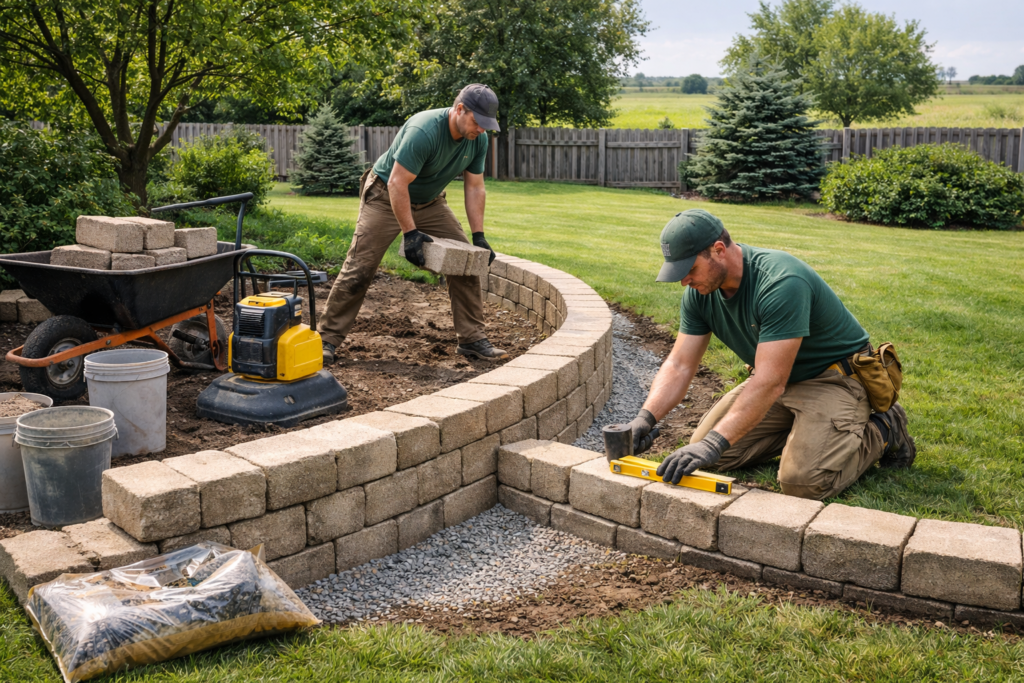
At Priority Lawn and Landscape, we’ve been installing retaining walls throughout Lincoln, NE for years. We’ve seen how the right wall in the right place can completely change how a homeowner uses their outdoor space.
This guide covers everything you need to know: when a retaining wall makes sense, what your options are, and what you should expect to pay for retaining wall installation in Lincoln.
Signs Your Lincoln Yard Needs a Retaining Wall
Not every slope needs a wall. Some gentle grades handle themselves just fine with the right plantings or ground cover. But certain warning signs tell you that you’re past the point where grass and mulch will cut it.
Visible Erosion and Soil Movement
Lincoln gets its share of heavy spring rains, and that water has to go somewhere. If you’re finding mulch or topsoil washed across your driveway after storms, or you can see channels carved into slopes in your yard, erosion is actively reshaping your landscape. Left alone, this gets worse every year. A retaining wall stops the process by holding soil in place and redirecting water flow.
Foundation Concerns
Soil that moves downhill doesn’t just disappear—it often ends up against foundations where it doesn’t belong, or it leaves behind voids that cause settling. If you’ve noticed cracks appearing in basement walls, doors that suddenly stick, or windows that won’t close properly, unstable soil could be part of the problem. A properly engineered retaining wall can take pressure off your foundation and prevent further movement.
Slopes You Can’t Use
That steep hill taking up half your backyard isn’t doing you any favors. You can’t mow it safely, kids can’t play on it, and you’ve given up trying to plant anything that survives. Retaining walls let you carve usable space out of difficult terrain—flat areas for fire pits, patios, gardens, or just a lawn you can actually enjoy.
Drainage Problems After Rain
Water that collects at the base of slopes, pools in certain areas of your yard, or flows toward your house instead of away from it signals a grading issue. While sometimes regrading alone solves this, many Lincoln properties need retaining walls to create proper drainage paths and prevent water from causing damage over time.
Types of Retaining Walls for Lincoln Properties
The material you choose affects everything from how long your wall lasts to how it looks in your landscape. Here’s what works well in Lincoln’s climate, where we deal with freeze-thaw cycles, heavy clay soils, and temperature swings from summer to winter.
Segmental Block Walls
These are the most common retaining walls we install in Lincoln. Made from precast concrete blocks that interlock without mortar, they’re engineered specifically for soil retention. The blocks come in various colors and textures that mimic natural stone, and they handle Nebraska’s freeze-thaw cycles without cracking the way poured concrete can.
Segmental walls work for heights from a couple of feet up to eight feet or more with proper engineering. For walls over four feet, most manufacturers require specific reinforcement methods using geogrid fabric that locks into the soil behind the wall, creating a much stronger structure than the blocks alone would provide.
Natural Stone Walls
Nothing beats the look of natural stone. Boulder walls and stacked limestone create a timeless appearance that blends with almost any landscape style. Stone walls work particularly well in Lincoln for smaller applications—garden borders, raised beds, and walls under three feet where the natural variation in stone adds character without compromising structural integrity.
The trade-off is cost and labor. Natural stone takes longer to install because each piece must be selected and placed individually. The material itself costs more than manufactured blocks. But for the right property and the right application, stone delivers a look that manufactured products can only approximate.
Timber Walls
Pressure-treated timber was the go-to retaining wall material for decades, and it still has its place. Timber walls cost less than stone or block, install quickly, and have a natural appearance that works well in wooded or rustic settings. They’re a reasonable choice for short walls in areas where longevity isn’t the primary concern.
The downside is lifespan. Even treated lumber eventually rots, especially in contact with soil and moisture. Expect a timber wall to last 15 to 20 years before needing replacement, compared to 50 years or more for properly built block or stone walls. In Lincoln’s wet springs and humid summers, wood deteriorates faster than in drier climates.
Poured Concrete Walls
For commercial applications, very tall walls, or situations where maximum strength is required, poured concrete is hard to beat structurally. Reinforced with steel rebar, these walls can handle enormous soil pressure and last indefinitely with minimal maintenance.
For residential landscapes in Lincoln, poured concrete is less common. The plain gray appearance doesn’t suit most yards, though the face can be veneered with stone or stucco. The bigger issue is cost—the formwork and labor involved in pouring concrete walls puts them at the high end of the price range. Most homeowners find that engineered block walls provide equivalent structural performance at lower cost with better aesthetics.
What Goes Into Retaining Wall Installation
A retaining wall that lasts starts below ground level. What you see above the surface is maybe half the story—the buried foundation and drainage system do the real work of keeping everything stable for decades.
Site Assessment and Design
Before any digging happens, we evaluate your specific situation. This means looking at how much soil the wall needs to retain, what type of soil we’re dealing with (Lincoln has everything from heavy clay to sandy loam depending on the neighborhood), existing drainage patterns, and where utilities run. For walls over four feet, this assessment usually involves engineering calculations to determine the right construction method.
Excavation and Base Preparation
The foundation trench gets dug below frost line—typically 36 inches in Lincoln—and filled with compacted gravel. This buried base is wider than the wall itself and leveled precisely. Skipping this step or skimping on compaction is why some walls start leaning within a few years. The gravel also provides drainage, letting water pass through instead of building up pressure behind the wall.
Wall Construction
Block walls go up row by row, with each course set back slightly from the one below (called “batter”). This backward lean counteracts the soil pressure pushing from behind. Between the wall and the retained soil goes a drainage layer—typically clean gravel wrapped in filter fabric to keep fine soil particles from clogging the system.
For taller walls, geogrid reinforcement gets installed at specific intervals. This synthetic mesh extends back into the compacted fill behind the wall, effectively tying the structure to a large mass of stabilized soil. It’s what allows a wall made of relatively small blocks to retain eight or ten feet of earth.
Drainage and Finishing
A perforated drain pipe runs along the base of the wall, collecting water that filters down through the gravel backfill. This pipe needs to daylight somewhere—either to a lower area of the yard, a storm drain connection, or a dry well. Trapped water is the enemy of retaining walls, creating hydrostatic pressure that can push even well-built walls out of position.
Once the wall reaches its final height, caps go on top for a finished look, and the area behind gets backfilled and graded to direct surface water away from the structure.
Retaining Wall Costs in Lincoln, NE
Pricing retaining walls isn’t straightforward because so many variables affect the final number. Here’s a realistic breakdown of what Lincoln homeowners can expect to pay, based on current material costs and typical project conditions.
Material Costs
Segmental concrete block typically runs $12 to $25 per square foot of wall face, depending on the product line and style you choose. Basic utility blocks cost less; premium products with natural stone textures cost more. Natural stone ranges from $25 to $50 per square foot depending on the type of stone and local availability. Pressure-treated timber is the budget option at $10 to $15 per square foot.
Labor and Installation
Labor typically adds another $15 to $30 per square foot for standard installations. Complex sites—steep slopes, limited equipment access, extensive excavation—push that higher. Very tall walls requiring engineered reinforcement also increase labor costs because of the additional materials and more demanding construction process.
Total Project Pricing
Putting it together, a typical retaining wall installation in Lincoln runs between $30 and $60 per square foot, all in. A modest wall—say 30 feet long and 3 feet tall, or 90 square feet of face area—might cost $3,000 to $5,500. A larger project with 200 square feet of wall could range from $6,000 to $12,000 or more depending on materials and site conditions.
These numbers assume reasonably accessible sites without major complications. Projects requiring extensive grading, tree removal, utility relocation, or engineered solutions for unusual soil conditions will cost more. The only way to get an accurate number for your specific situation is a site visit and detailed estimate.
What Affects Your Price
Height matters more than length. A wall that’s twice as tall doesn’t cost twice as much—it costs considerably more because of the additional excavation, materials, and often the need for engineered reinforcement. A four-foot wall requires substantially more work per linear foot than a two-foot wall.
Site access affects equipment options. If we can get a skid steer or mini excavator to your project site, work goes faster and costs less than hand-digging and hand-carrying materials through a narrow side yard. Soil conditions matter too—sandy soil drains well and excavates easily, while heavy clay requires more attention to drainage and compacts differently.
Curves, corners, and steps add labor time. A straight wall along a property line is simpler to build than one that curves around existing trees or steps down in tiers. These features often improve the final appearance, but they do increase installation time.
Permits and Regulations in Lincoln
Lincoln’s building code requires permits for retaining walls over four feet in height, measured from the bottom of the footing to the top of the wall. This applies to the total retained height, not just what shows above grade. If you’re building a wall that holds back four feet of soil but only three feet is visible, you still need a permit.
Walls this size also require engineered drawings—a structural engineer must design the wall and stamp the plans before the city will issue a permit. This adds cost (typically $500 to $1,500 for engineering) but protects you by ensuring the wall is designed properly for your specific conditions.
Setback requirements apply too. Retaining walls generally can’t be built right on a property line; specific setback distances depend on your zoning district and the wall’s height. In some cases, walls near the property line require a surveyor to mark the exact boundary first.
For walls under four feet, permits usually aren’t required, but other rules still apply. You still need to respect property lines, maintain proper drainage so you’re not directing water onto neighboring properties, and call 811 before digging to have utilities marked.
Keeping Your Retaining Wall in Good Shape
A properly installed retaining wall shouldn’t need much attention, but some basic maintenance extends its life and catches small problems before they become expensive repairs.
Check drainage outlets after heavy rains. The pipe that carries water away from behind your wall should flow freely. If it’s clogged with sediment or debris, water pressure builds up behind the wall—the number one cause of retaining wall failure. Clearing these outlets takes five minutes and prevents serious problems.
Watch for leaning or bulging. Walk along your wall once or twice a year and look for any spots that seem to be pushing outward or tilting. Small movements can indicate drainage problems or settling that’s better addressed early. Catching a developing problem at an inch of movement is far easier to fix than waiting until the wall has shifted six inches.
Keep plantings in check. Tree roots can gradually displace retaining wall blocks, and ground cover that spreads into joints can trap moisture. Choose plants that complement your wall without threatening its structure—ornamental grasses, small shrubs, and perennials work better than trees planted right at the wall’s base.
Remove debris and keep weeds from establishing in wall joints. This is mostly about appearance, but vegetation in joints can hold moisture against the blocks and accelerate weathering in concrete products.
Why Retaining Walls Aren’t a DIY Project
The videos make it look simple: dig a trench, lay some blocks, backfill. Reality is more complicated, and failed retaining walls are expensive to fix.
The margin for error is small. A base that’s off by even an inch affects every course above it. Inadequate compaction causes settling that shows up two or three years later as a crooked, leaning wall. Poor drainage—the most common DIY mistake—creates pressure that pushes walls over during wet seasons. By the time you see these problems, the only fix is usually tearing everything out and starting over.
Professional installation also means professional accountability. A reputable contractor stands behind their work; if something goes wrong, they fix it. With DIY, you own whatever happens. Given that a wall failure can involve not just replacing the wall but repairing whatever it damaged—landscaping, patios, sometimes even structures downhill—the risk isn’t worth the savings for most homeowners.
That said, small decorative walls—a couple of courses high, not actually retaining significant soil—are reasonable DIY projects if you’re handy and willing to do the research. True retaining walls, the kind that hold back slopes and prevent erosion, deserve professional attention.
Get a Retaining Wall Estimate for Your Lincoln Property
Every property is different, and the only way to know exactly what your retaining wall project will involve is to look at your specific situation. At Priority Lawn and Landscape, we’ve been solving drainage problems and transforming Lincoln yards with quality retaining walls for years.
If you’re dealing with erosion, struggling with a slope you can’t use, or just want to add some structure and visual interest to your landscape, we’d be happy to take a look and give you an honest assessment of your options. Our estimates are detailed, our pricing is straightforward, and we don’t do high-pressure sales.
Contact Priority Lawn and Landscape today to schedule a consultation and find out what retaining wall installation in Lincoln would look like for your yard.
EXCELLENTTrustindex verifies that the original source of the review is Google. Priority did a great job. Would recommend to anyonePosted onTrustindex verifies that the original source of the review is Google. Bryce was awesome from the design meeting throughout the project. Very professional and a great job on my new grill area on THANKSPosted onTrustindex verifies that the original source of the review is Google. Posted onTrustindex verifies that the original source of the review is Google. Posted onTrustindex verifies that the original source of the review is Google. Excellent, quality work. Very professional, knowledgeable, and skilled.! Excited to work with this company in the future!Posted onTrustindex verifies that the original source of the review is Google. Huge shoutout to Bryce and the whole Priority team who came out last week. Bryce was super helpful in figuring out the drainage issue we had going on and really gave us a good idea of what to expect and how it could be fixed. Also the quote was incredibly reasonable compared to many others we talked to. They did a great job getting the drainage done and we are already seeing a big difference in our yard. They also were awesome getting everything cleaned up. The biggest thing was how awesome they were to my 6 year old. He was so interested with what was going on, and they let him get involved and help out. For like 4-5 hours he was out there moving dirt and "helping." Hopefully it was not too much of a bother. Anyways, thanks a ton to the Bryce and his team!Posted onTrustindex verifies that the original source of the review is Google. We are so pleased with the results of our landscaping project. Bryce provided us with invaluable suggestions, detailed (and reasonable) pricing estimates, and a timely schedule. His crew was very professional and attentive to last minute changes. Thank you!Posted onTrustindex verifies that the original source of the review is Google. I am so happy with Priority One! In just a few weeks, our yard is healthy, green, and growing! Our shrubs are beautifully thriving and trimmed. I am so excited for our landscaping project to begin very soon! Great customer service, attention to detail and knowledgeable! Thank you!Posted onTrustindex verifies that the original source of the review is Google. Great service and quick response when we need somethingPosted onTrustindex verifies that the original source of the review is Google. They did the job exactly as promised and cleaned up nicely when finished. Well pleased.Verified by TrustindexTrustindex verified badge is the Universal Symbol of Trust. Only the greatest companies can get the verified badge who has a review score above 4.5, based on customer reviews over the past 12 months. Read more
