
The Best Trees and Shrubs for Lincoln, NE Yards
Lincoln sits in USDA Hardiness Zones 5b to 6a, which means winter lows can dip to -15°F and summer heat regularly pushes past 95°F. That’s a wide swing, and not every tree or shrub handles it well. Add in Lancaster County’s heavy clay soil — with its slow drainage and tendency to compact — and your plant selection matters even more than the average gardening article lets on.
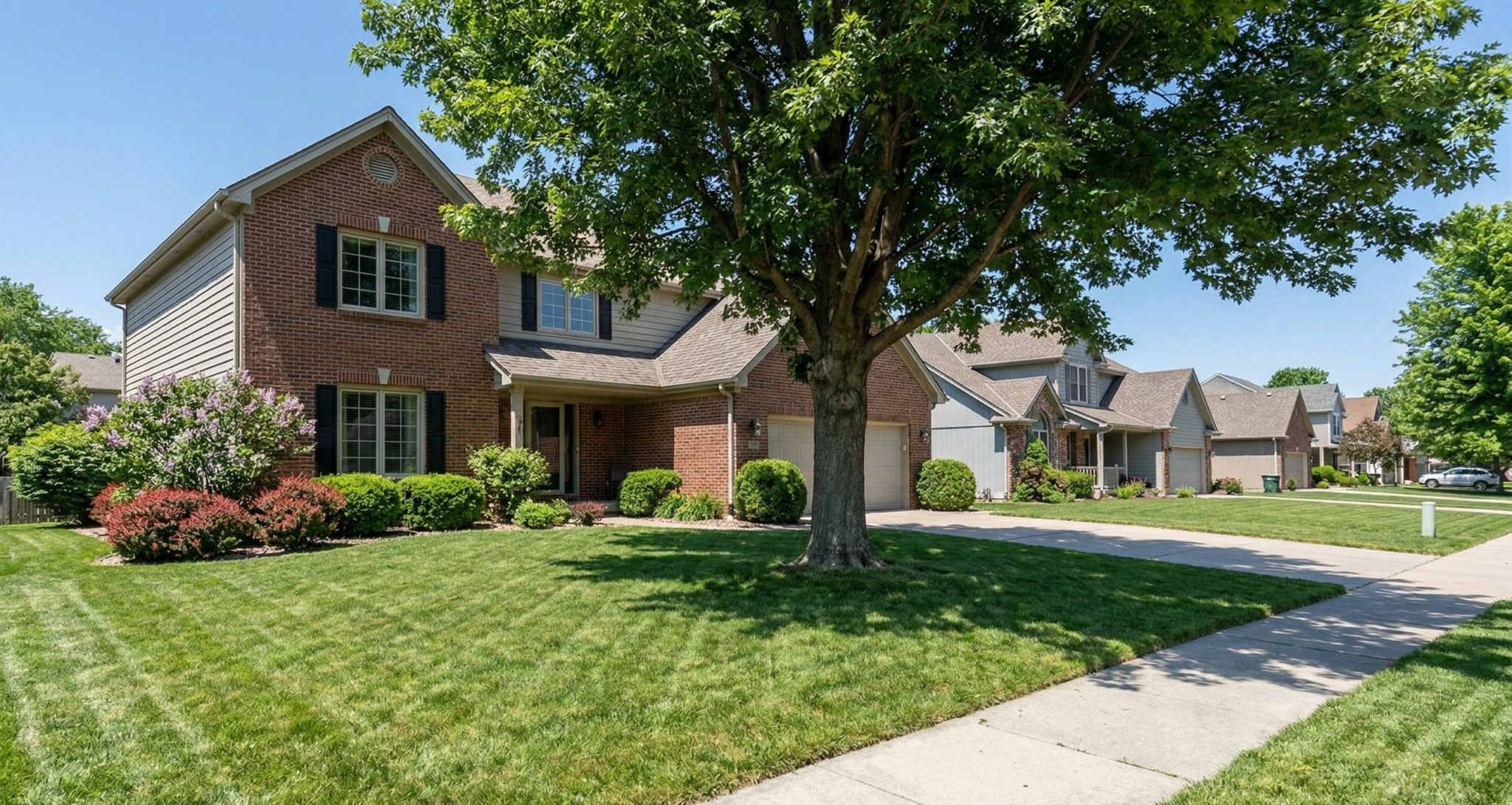
We’ve been planting trees and shrubs across Lincoln neighborhoods for years. Here’s what actually thrives, what costs look like, and when to get things in the ground.
Why Tree and Shrub Selection Matters in Lincoln, Nebraska
Picking trees for Lincoln, NE landscaping isn’t just about curb appeal. The wrong species can mean cracked foundations from aggressive root systems, dead limbs from ice storms, or a tree that looks great for three years and then slowly declines because it can’t handle our alkaline clay.
Lincoln’s soil pH typically runs between 7.0 and 8.0. That’s a problem for acid-loving species like pin oaks and red maples — both of which develop iron chlorosis here, turning their leaves yellow from the veins out. You’ll see it all over town. It’s fixable with annual iron treatments, but why fight it when better options exist?
The city also has specific regulations worth knowing. Lincoln’s municipal code requires that street trees come from an approved species list, and the city forester’s office can reject plantings that interfere with utility easements or sight lines at intersections. If you’re planting in the boulevard strip between the sidewalk and street, check with the city first.
Best Shade Trees for Lincoln, NE
These are the large canopy trees that anchor a yard. Plan on 30 to 50 feet of mature height for most of these, so placement relative to the house, power lines, and property lines matters.
Bur Oak (Quercus macrocarpa)
The bur oak is native to eastern Nebraska and about as tough as a tree gets in this climate. It handles clay soil, drought, alkaline pH, and ice loads without complaint. Mature specimens develop that classic wide-spreading canopy — 60 to 80 feet across on open-grown trees. Growth rate is moderate, roughly 12 to 18 inches per year once established.
The downside is patience. Bur oaks are slow starters. The first two to three years, most of the growth happens underground as the taproot develops. After that, above-ground growth picks up noticeably.
Cost for a 2-inch caliper balled-and-burlapped specimen runs $350 to $550 installed in the Lincoln market. Larger 3- to 4-inch caliper trees push $800 to $1,200 with installation.
Kentucky Coffeetree (Gymnocladus dioicus)
This one has gained a lot of ground in Lincoln over the past decade, and for good reason. It’s native to the region, tolerates alkaline clay, and has an open branching structure that lets filtered light through to the lawn below. The wood is extremely strong — ice storm damage is rare.
Go with a male cultivar like ‘Espresso’ to avoid the large seed pods that females drop. The only real knock on this tree is that it leafs out late in spring and drops early in fall, so your shade season is shorter than with a maple or oak.
Expect $400 to $700 installed for a 2- to 2.5-inch caliper tree.
Hackberry (Celtis occidentalis)
Hackberry doesn’t get much love in the nursery trade, but it’s one of the most reliable trees in Lincoln. It handles poor soil, drought, wind, and urban conditions. Growth rate is moderate to fast — 18 to 24 inches per year. The warty bark gives it a distinct winter look.
The main drawback is nipple gall, a cosmetic issue caused by tiny insects that create bumps on the leaves. It looks odd but doesn’t harm the tree. Some homeowners can’t get past it.
Hackberry is one of the more affordable shade trees. Budget $250 to $450 installed for a 2-inch caliper specimen.
Swamp White Oak (Quercus bicolor)
Despite the name, swamp white oak does well in Lincoln’s clay because it tolerates both wet and moderately dry conditions. It grows faster than bur oak — about 18 to 24 inches per year — and the fall color is a reliable yellow to russet. It handles our alkaline soil without the chlorosis problems that plague pin oak.
Pricing is similar to bur oak: $350 to $600 installed for a 2-inch caliper tree.
Trees to Avoid for Shade
A few species that get planted too often in Lincoln despite known problems:
- Silver Maple: Fast growth, but weak wood that splits in ice storms and wind. Aggressive surface roots heave sidewalks and invade sewer lines. Short-lived for a shade tree.
- Pin Oak: Develops severe iron chlorosis in our alkaline soil. Leaves turn yellow every summer. The lower branches droop and require constant pruning for clearance.
- Bradford Pear: Structurally weak branching pattern. Most split apart within 15 to 20 years. Lincoln’s 2020 ice storm destroyed hundreds of them across town. Also invasive — the callery pear rootstock produces thorny seedlings that spread into natural areas.
Best Ornamental Trees for Lincoln Yards
Ornamental trees fill the 15- to 30-foot range. They work well near patios, in foundation plantings, and under power lines where full-size shade trees won’t fit.
Eastern Redbud (Cercis canadensis)
Redbud blooms in April before the leaves emerge — clusters of pink to purple flowers right on the branches and even the trunk. It’s one of the first color shows of Lincoln’s spring. Mature size runs 20 to 30 feet tall and wide.
Plant it in a spot with some afternoon shade protection. Redbuds handle Lincoln winters fine, but they prefer slightly more moisture than our clay naturally provides during July and August droughts. A 2- to 3-inch layer of mulch over the root zone makes a big difference.
Installed cost for a 1.5- to 2-inch caliper tree runs $300 to $500.
Serviceberry (Amelanchier species)
Serviceberry checks a lot of boxes: white spring flowers, edible berries in June, strong orange-red fall color, and attractive gray bark in winter. It stays in the 15- to 25-foot range, making it a good fit for smaller lots.
Both the single-stem tree forms (like ‘Autumn Brilliance’) and multi-stem clump forms work well in Lincoln. Birds will find the berries before you do, which is either a feature or a bug depending on your perspective.
Expect $250 to $450 installed.
Japanese Tree Lilac (Syringa reticulata)
This is a workhorse ornamental for Lincoln. It tops out around 20 to 25 feet, blooms with large creamy-white flower clusters in June (after common lilacs finish), and handles clay soil and urban conditions. ‘Ivory Silk’ is the most widely available cultivar and it’s a solid choice.
The flowers have a privet-like fragrance that some people love and others find too strong. Worth smelling one in bloom before you commit.
Installed cost is $300 to $500 for a 1.5- to 2-inch caliper tree.
Best Shrubs for Lincoln, Nebraska Landscapes
Shrubs in Lincoln, Nebraska need to handle the same clay soil and temperature swings as the trees, but they also take more direct abuse from road salt spray, snow load from roof runoff, and reflected heat off foundations and driveways.
Dwarf Bush Honeysuckle (Diervilla lonicera)
Not to be confused with the invasive Amur honeysuckle (which you should rip out if you have it), native bush honeysuckle is a tough, low-maintenance shrub that tops out at 3 to 4 feet. Yellow summer flowers, reddish fall foliage, and it spreads to fill in gaps without getting out of control.
It handles shade, clay, and dry conditions — useful for that north-side-of-the-house spot where nothing else wants to grow.
Cost runs $25 to $45 per container-grown plant installed.
Ninebark (Physocarpus opulifolius)
Ninebark has become one of the most popular shrubs in Lincoln landscaping over the past several years, and the colored-leaf cultivars are the reason. ‘Diablo’ has deep burgundy foliage, ‘Center Glow’ shows red-to-gold gradients, and ‘Little Devil’ stays compact at 3 to 4 feet.
It’s native, drought-tolerant once established, and virtually pest-free in our area. The peeling bark adds winter interest. Give it full sun for the best leaf color — shade washes out the burgundy cultivars to a muddy green.
Installed cost is $35 to $60 per plant depending on cultivar and size.
Arrowwood Viburnum (Viburnum dentatum)
Arrowwood is a 6- to 10-foot shrub that works well as a screen, hedge, or background plant. White flower clusters in late spring, blue-black berries that birds go after in fall, and reliable burgundy to red fall color. It handles clay and partial shade.
‘Blue Muffin’ is a compact cultivar (5 to 7 feet) that’s become widely available at Lincoln nurseries. Good option if you want the viburnum look without the full size.
Plan on $30 to $50 per plant installed.
Spirea (Spiraea species)
Spirea is the reliable default for foundation plantings in Lincoln, and honestly, it earns that spot. ‘Goldmound’ and ‘Gold Flame’ offer yellow to chartreuse foliage with pink summer flowers. ‘Little Princess’ stays compact with pink blooms on green foliage.
They max out at 2 to 4 feet depending on cultivar, handle full sun to light shade, and tolerate heavy pruning if they get leggy. About the lowest-maintenance flowering shrub you can plant here.
Cost is $20 to $40 per plant installed — one of the most affordable shrub options.
Shrubs for Lincoln, Nebraska to Avoid
- Burning Bush (Euonymus alatus): Nebraska lists it as a potentially invasive species. The seeds spread into natural areas via birds. Some nurseries still sell it, but there are better options for red fall color.
- Common Privet: Gets hammered by late spring freezes in Lincoln. Die-back to the ground isn’t unusual after a hard April frost, and we get those more often than you’d think.
- Amur Honeysuckle: Invasive. Already a major problem in Lincoln’s parks and natural areas. If you have it on your property, removing it is a favor to the neighborhood.
Evergreen Options for Year-Round Structure
Lincoln winters are long and gray. Evergreens give your yard structure from November through April when everything else is bare.
Eastern Red Cedar (Juniperus virginiana)
It’s the native evergreen of the Great Plains and grows wild across Lancaster County. As a landscape plant, cultivars like ‘Taylor’ (narrow, columnar form) and ‘Canaertii’ (pyramidal with blue berries) give you more controlled shapes than the wild type. Extremely drought-tolerant and unbothered by clay.
The main caution: eastern red cedar is an alternate host for cedar-apple rust. If you have apple or crabapple trees nearby, the rust fungus cycles between them. It’s manageable but worth knowing.
Installed cost for a 5- to 6-foot specimen runs $200 to $400.
Black Hills Spruce (Picea glauca var. densata)
This is a better bet than Colorado blue spruce for Lincoln. Blue spruce looks great for the first 10 to 15 years, then often declines from needle cast diseases and cytospora canker — you’ll see plenty of examples around town with dead lower branches and thin crowns.
Black Hills spruce is denser, more compact, and more disease-resistant in our climate. It grows slower (6 to 12 inches per year) but stays healthier long-term. Mature size is 30 to 50 feet.
Budget $300 to $600 installed for a 5- to 6-foot tree.
Boxwood (Buxus ‘Green Velvet’ or ‘Green Mountain’)
For a formal evergreen hedge or foundation accent, boxwood works in Lincoln if you pick the right cultivar. ‘Green Velvet’ and ‘Green Mountain’ are rated hardy to Zone 4 and handle our winters. Avoid English boxwood — it’s not reliable this far north.
Plant boxwood in a spot with some wind protection, especially from winter sun and southwest wind that causes leaf scorch. East- or north-facing foundation beds are ideal.
Cost is $35 to $65 per plant installed depending on size.
When to Plant Trees and Shrubs in Lincoln
Timing makes a real difference in establishment success. Here’s the seasonal breakdown for Lincoln’s climate:
- Fall (mid-September through late October): The best window for most trees and shrubs. Soil is still warm enough for root growth, but air temperatures are cooling so the plant isn’t fighting to support a full canopy. Fall-planted trees typically establish a full growing season ahead of spring-planted ones.
- Spring (mid-March through mid-May): The second-best window. Get plants in the ground after the soil thaws but before summer heat arrives. Earlier is better — an April planting gives roots more time to develop before July drought stress hits.
- Summer (June through August): Possible but risky. If you plant in summer, commit to consistent watering — at least 1 inch per week for new trees, applied slowly at the base. Container-grown stock handles summer planting better than balled-and-burlapped.
- Winter (November through March): Dormant planting works for balled-and-burlapped trees as long as the ground isn’t frozen. Some landscape crews in Lincoln plant large trees through December. Once the ground freezes solid, you’re done until spring.
What Trees and Shrubs Cost in the Lincoln Market
Pricing varies by species, size, nursery, and whether installation is included. Here’s a general range based on current Lincoln-area pricing:
- Shade trees (2-inch caliper, installed): $350 to $700
- Ornamental trees (1.5- to 2-inch caliper, installed): $250 to $500
- Evergreen trees (5 to 6 feet, installed): $200 to $600
- Shrubs (3- to 5-gallon container, installed): $25 to $65 per plant
- Hedge plantings (per linear foot, installed): $15 to $40 depending on species and spacing
Installation typically includes the plant, digging, backfill amendments if needed, initial mulching, and a staking kit for trees. Most Lincoln landscapers offer a one-year warranty on installed plant material, though terms vary — ask about warranty specifics before signing a contract.
For larger projects — say, a full backyard overhaul with five or more trees and a dozen shrubs — most Lincoln landscaping companies will discount the per-plant cost. It’s worth getting at least three bids and comparing not just price but what’s included in the warranty.
Soil Prep Tips for Lancaster County Clay
You can pick the perfect species and still lose it if the planting hole turns into a bathtub. Lancaster County clay drains slowly, and a common mistake is digging a deep, narrow hole that holds water around the root ball.
Dig the hole two to three times wider than the root ball but no deeper than the root ball itself. The top of the root flare should sit at or slightly above grade. In heavy clay, planting an inch or two high and mounding soil up to the root flare actually improves drainage and prevents crown rot.
Skip the old advice about amending the backfill with compost or peat moss. Research from university extension programs — including Nebraska Extension — shows that amending just the planting hole creates a “container effect” where roots circle inside the amended soil and never push out into the native clay. Backfill with the same soil you dug out.
What does help: a 3-inch ring of wood chip mulch over the root zone, pulled back 2 to 3 inches from the trunk. Mulch moderates soil temperature, retains moisture, and breaks down over time to improve the clay’s structure at the surface.
Hiring a Lincoln Landscaping Company for Tree and Shrub Installation
Not every landscaping crew in Lincoln handles tree and shrub planting the same way. A few questions worth asking before you hire:
- What size root ball or container do you typically install for this species?
- Do you include staking, and for how long?
- What does your plant warranty cover — replacement only, or replacement plus labor?
- Will you call 811 for utility locates before digging?
- Do you pull mulch away from the trunk, or volcano mulch? (If they volcano mulch, that’s a red flag.)
At Priority Lawn and Landscape, we handle the full process — species selection based on your specific site conditions, utility locates, proper planting depth, mulching, and follow-up care instructions. We know which species do well in which Lincoln neighborhoods because we’ve been planting across the city for years.
If you’re planning a new planting project or replacing trees and shrubs that haven’t performed, give us a call or fill out our contact form. We’ll walk your property and put together a plan that fits your yard and your budget.
EXCELLENT Based on 26 reviews
 Posted on Google
 Kelsey SlausonPosted on Google
 Amy JensenThank you Priority Lawn for taking care of my yard! I had lots of weeds and unwanted plants growing throughout my yard. I had contacted a few other places and found that they only spray weeds and do not dig them up. What a disappointment! Not only did Priority Lawn take care of them all they did a fantastic job!Posted on Google
 RyanPriority did a great job. Would recommend to anyonePosted on Google
 David MattinglyBryce was awesome from the design meeting throughout the project. Very professional and a great job on my new grill area on THANKSPosted on Google
 Barbara AndersonPosted on Google
 Alex SwiatekPosted on Google
 Diane HudsonExcellent, quality work. Very professional, knowledgeable, and skilled.! Excited to work with this company in the future!Posted on Google
 Tahner PHuge shoutout to Bryce and the whole Priority team who came out last week. Bryce was super helpful in figuring out the drainage issue we had going on and really gave us a good idea of what to expect and how it could be fixed. Also the quote was incredibly reasonable compared to many others we talked to. They did a great job getting the drainage done and we are already seeing a big difference in our yard. They also were awesome getting everything cleaned up. The biggest thing was how awesome they were to my 6 year old. He was so interested with what was going on, and they let him get involved and help out. For like 4-5 hours he was out there moving dirt and "helping." Hopefully it was not too much of a bother. Anyways, thanks a ton to the Bryce and his team!Posted on Google
 Sonja KroppWe are so pleased with the results of our landscaping project. Bryce provided us with invaluable suggestions, detailed (and reasonable) pricing estimates, and a timely schedule. His crew was very professional and attentive to last minute changes. Thank you!Posted on Google
 KIM KingI am so happy with Priority One! In just a few weeks, our yard is healthy, green, and growing! Our shrubs are beautifully thriving and trimmed. I am so excited for our landscaping project to begin very soon! Great customer service, attention to detail and knowledgeable! Thank you!Verified by TrustindexTrustindex verified badge is the Universal Symbol of Trust. Only the greatest companies can get the verified badge who has a review score above 4.5, based on customer reviews over the past 12 months. Read more
About the Author
