
How Much Does Landscaping Cost in Lincoln, NE?
“How much does landscaping cost?” is the most common question we hear, and the honest answer is: it depends.
A spring mulch refresh and bed cleanup might run $300. A full front yard redesign with a paver walkway, new plantings, lighting, and irrigation could hit $25,000. Those are both “landscaping.”
What actually helps is breaking it down by project type with real price ranges from the Lincoln, NE market — not national averages that don’t account for our labor rates, material costs, clay soil conditions, or the freeze-thaw demands that drive up base preparation on every hardscape job.
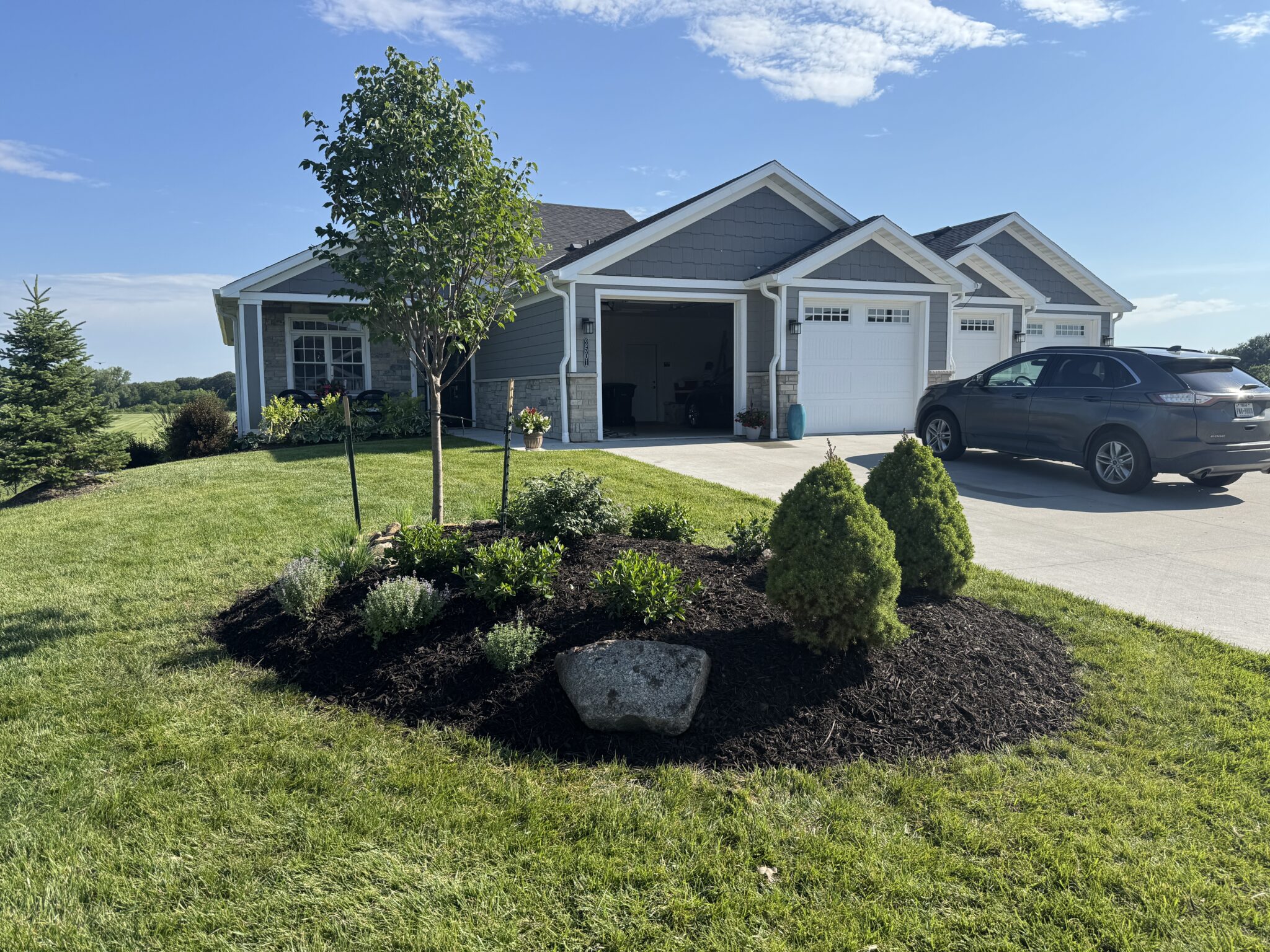
This guide covers what Lincoln homeowners typically pay for the most common landscaping services and installations, what affects pricing, and where your dollar goes furthest.
Lawn Care and Maintenance Costs
Ongoing lawn maintenance is where most Lincoln homeowners start. These are recurring costs, either as DIY expenses or professional service fees.
Mowing
Professional weekly mowing in Lincoln runs $30–$55 per visit for a standard residential lot (5,000–8,000 sq ft of turf). That typically includes mowing, string trimming, and blowing clippings off hard surfaces. Larger properties, lots with obstacles, or yards that require more trimming time push toward the higher end.
A full-season mowing contract (roughly April through November, 28–32 visits) runs $840–$1,760 per year. Most Lincoln lawn care companies offer a slight discount for seasonal contracts versus per-visit pricing.
Fertilization and Weed Control
A professional fertilization and weed control program in Lincoln — usually 5–6 applications from spring through fall — costs $300–$600 per year for an average-sized yard. That includes pre-emergent crabgrass control, broadleaf weed treatments, and slow-release fertilizer timed to Lincoln’s Zone 5b growing season.
DIY fertilizer and herbicide products for the same yard run $120–$220 per year in materials, but you’re providing the labor, equipment, and timing precision.
Core Aeration and Overseeding
This is the single most important annual maintenance service for lawns on Lancaster County’s clay soil. Professional aeration runs $80–$175 for an average Lincoln yard. Add overseeding and starter fertilizer and the total is $150–$300.
Renting a core aerator and doing it yourself costs $75–$100 for a half-day rental, plus $30–$60 for seed. The tradeoff is wrestling a 200-pound machine around your yard and getting even coverage.
Grub Prevention
A preventive grub application (June timing, watered in) costs $60–$100 through a professional service. Skipping it is a gamble — curative treatments after grub damage appears are less effective and the lawn repair costs on top of treatment can easily exceed $500–$1,000.
Irrigation System Maintenance
Spring startup runs $75–$125. Fall winterization (blowout) costs $65–$125. Both are essentially non-negotiable in Lincoln — skipping the fall blowout risks freeze damage to lines, valves, and the backflow preventer that can cost $300–$1,000+ to repair.
Mid-season repairs vary widely. A broken head replacement is $15–$30 in parts plus a service call ($75–$125). A zone valve replacement runs $150–$300. A full system audit and adjustment costs $100–$200.
Landscape Planting Costs
Planting is where most homeowners start to see real transformation in their yard. Costs depend on plant size, species, soil preparation needed, and how much existing material has to be removed.
Shrubs
Installed pricing for shrubs in Lincoln typically falls in these ranges:
- Small shrubs (1–2 gallon container, like dwarf spirea or boxwood): $40–$75 per plant installed, including soil amendment and mulch
- Medium shrubs (3–5 gallon, like panicle hydrangea or ninebark): $75–$150 per plant installed
- Large shrubs (7–15 gallon or balled-and-burlapped, like viburnum or large lilac): $150–$350 per plant installed
A typical foundation planting refresh for a Lincoln home — removing old overgrown material, amending the clay soil, installing 8–15 new shrubs and a few perennial groupings, and mulching — runs $2,000–$6,000 depending on scope and plant sizes.
Perennials and Groundcovers
Perennials installed in groups (the way they should be planted for visual impact) run $8–$15 per plant installed for 1-gallon containers. A grouping of 5–7 coneflowers, daylilies, or Russian sage with soil prep and mulch might cost $75–$125 per cluster.
Groundcover plantings (creeping juniper, vinca, sweet woodruff, sedge) for areas where turf won’t grow run $5–$12 per square foot installed, depending on plant spacing and species. A 200 sq ft shade garden under a mature tree costs $1,000–$2,400 to plant out.
Trees
Tree costs vary significantly by species, size, and access:
- 1.5–2 inch caliper (the most common residential planting size): $300–$800 installed, including staking and initial watering setup
- 2.5–3 inch caliper (faster impact, still manageable to plant): $600–$1,200 installed
- 3–4 inch caliper (large specimen, requires equipment): $1,000–$2,500+ installed
- Large specimen trees (4+ inch caliper, truck-delivered): $2,500–$5,000+ depending on species, access, and site conditions
Native and well-adapted species for Lincoln (bur oak, Kentucky coffeetree, honeylocust, hackberry, serviceberry) are generally at the lower end of their size category. Specialty ornamental trees and less common cultivars cost more because availability is limited in the regional nursery trade.
Tree Removal
On the other end, removing a tree in Lincoln runs $200–$800 for a small tree (under 20 feet), $800–$2,000 for a medium tree (20–40 feet), and $1,500–$4,000+ for a large tree (40+ feet). Stump grinding adds $100–$400 depending on diameter. Access, proximity to structures, and whether the tree is dead or hazardous all affect pricing.
Lincoln does not require a permit for tree removal on private property in most cases, but trees in the right-of-way (between sidewalk and street) are managed by the city. Check with Lincoln Parks and Recreation before removing any street tree.
Mulch
Bulk hardwood mulch in Lincoln costs $30–$50 per cubic yard, with delivery fees of $30–$75 depending on the supplier and distance. One cubic yard covers approximately 100 sq ft at 3 inches deep.
Professional mulch installation (including bed edging, weed removal, and application) runs $75–$100 per cubic yard installed. A typical Lincoln home needs 4–8 cubic yards for all beds, putting a full mulch refresh at $300–$800.
Dyed mulch (red, black) costs $5–$15 more per yard than natural hardwood. It fades unevenly and bleeds color in rain — natural brown or dark brown holds up better and looks more professional.
Hardscape Installation Prices
Hardscaping is where landscaping costs climb, but it’s also where the most durable, long-term value sits. A well-built patio or walkway outlasts plantings by decades.
Lincoln’s freeze-thaw cycle adds cost to every hardscape project because proper base preparation is non-negotiable. Skimping on the base — less than 6 inches of compacted Class 5 gravel for most applications — saves money upfront and costs far more in heaving, cracking, and replacement within 3–5 years.
Patios
Patio costs in Lincoln break down by material:
- Concrete pavers (Holland, tumbled, or permeable): $18–$30 per square foot installed, including excavation, 6-inch gravel base, sand setting bed, and polymeric sand joints
- Natural flagstone (dry-laid on gravel base): $22–$38 per square foot installed
- Natural flagstone (mortar-set on concrete base): $30–$50 per square foot installed
- Stamped or decorative concrete: $12–$20 per square foot installed
- Standard broom-finish concrete: $8–$14 per square foot installed
For reference, a 300 sq ft paver patio — a common size for a Lincoln backyard — runs $5,400–$9,000 installed. A 500 sq ft patio (enough for a dining area and seating space) costs $9,000–$15,000.
These prices include standard base preparation for Lincoln’s clay soil. If the site has poor drainage, high water table, or significant grade changes, additional site work can add $1,000–$3,000.
Walkways
Front walkway costs follow the same per-square-foot ranges as patios, but the total is driven by length and width:
- 4-foot-wide paver walkway, 30 feet long (120 sq ft): $2,160–$3,600
- 5-foot-wide paver walkway, 30 feet long (150 sq ft): $2,700–$4,500
- Natural stone walkway, same dimensions: $3,300–$7,500
Replacing a deteriorated concrete walkway requires removal and disposal of the old concrete. Concrete removal adds $3–$6 per square foot to the project.
Retaining Walls
Retaining wall pricing in Lincoln depends on material, height, and site access:
- Segmental block (like Versa-Lok or Belgard): $20–$40 per square face foot installed, including base preparation and drainage behind the wall
- Natural stone (limestone, fieldstone): $35–$60 per square face foot installed
- Poured concrete (typically for structural walls): $30–$50 per square face foot, plus forming and finish costs
- Boulder walls (natural stone boulders stacked or placed): $25–$50 per square face foot, depending on stone size and source
A 50-linear-foot retaining wall at 2 feet tall (100 sq ft of face) costs $2,000–$4,000 in block or $3,500–$6,000 in natural stone.
Walls over 4 feet tall in Lincoln require a building permit and typically need an engineered design, which adds $500–$1,500 in engineering fees. The wall itself costs more per square foot at greater heights because of reinforcement, geogrid, and drainage requirements.
Steps and Stoops
Front entry steps in stone or pavers run $100–$200 per linear foot of step, depending on material and complexity. A set of three steps across a 5-foot-wide entry might cost $1,500–$3,000. A larger stoop or landing area adds to the total based on square footage.
Concrete steps are less expensive ($50–$100 per linear foot) but offer fewer design options.
Drainage Solutions
Drainage issues are common in Lincoln because of the clay soil, and they’re not optional to fix — water problems get worse every year and can cause foundation damage that dwarfs the cost of the repair.
Common Drainage Projects and Costs
- Regrading along foundation (establishing proper slope away from the house): $500–$2,000 per side, depending on length, access, and how much soil needs to be moved
- French drain installation: $25–$60 per linear foot, including trenching, perforated pipe, gravel, and landscape fabric. A 50-foot run costs $1,250–$3,000
- Dry creek bed (surface drainage channel with decorative stone): $1,500–$5,000 depending on length, width, and stone selection
- Catch basin and underground pipe: $300–$800 per basin installed, plus $10–$20 per linear foot of solid pipe to the discharge point
- Downspout extensions (underground, with pop-up emitter): $150–$400 per downspout
- Channel drain across driveway: $30–$60 per linear foot installed
A professional drainage assessment in Lincoln typically costs $100–$250 and is worth the investment before committing to a solution. The wrong fix wastes money and can redirect water problems to a new location.
Irrigation System Installation
A new in-ground irrigation system for a typical Lincoln residential property (front and back yard, 6,000–10,000 sq ft of turf and beds) costs $3,000–$6,000 installed. That includes trenching, pipe, heads, valves, controller, and backflow preventer.
Larger properties, drip zones for beds, smart controllers (Wi-Fi enabled, weather-responsive), and more zones push costs toward $5,000–$8,000.
Key factors that affect irrigation pricing in Lincoln:
- Number of zones: Each zone adds $300–$500 to the system cost. Most residential systems need 5–10 zones depending on layout and water pressure.
- Backflow preventer type: Lincoln requires backflow prevention on all irrigation systems. A pressure vacuum breaker (PVB) is standard ($200–$400 installed). A reduced pressure zone (RPZ) assembly, required in some situations, costs $400–$800.
- Soil conditions: Lincoln’s clay is harder to trench than sandy soil, which can add labor time. Most installers price this into their standard rates for the Lincoln market.
- Smart controller upgrade: A basic controller comes with most systems. Upgrading to a Wi-Fi-enabled smart controller (Rachio, Hunter Hydrawise, or similar) adds $150–$300 but reduces water waste significantly.
Outdoor Living Features
These are the projects that turn a yard into usable living space. Costs vary widely based on complexity, materials, and site conditions.
Fire Pits
- Prefabricated fire pit ring on gravel pad (DIY-friendly): $300–$800
- Built-in wood-burning fire pit with stone or block surround: $1,500–$4,000 installed
- Gas fire pit with plumbing and stone surround: $3,000–$8,000 installed, depending on materials and gas line length
- Fire pit with integrated seating wall: Add $50–$100 per linear foot of wall to the fire pit cost
Lincoln doesn’t require permits for ground-level fire pits, but open burning is restricted under the municipal code — recreational fires must use clean, dry wood and not produce excessive smoke. Gas fire pits avoid this issue entirely.
Pergolas
- Pressure-treated pine pergola (12×12 feet, freestanding): $4,000–$7,000 installed
- Cedar pergola (same size): $6,000–$10,000 installed
- Vinyl or aluminum pergola: $8,000–$15,000 installed, but essentially maintenance-free
- Attached pergola (bolted to house): Similar pricing but requires a building permit in Lincoln
Outdoor Kitchens
- Basic built-in grill station (grill, countertop, storage): $3,000–$6,000
- Mid-range outdoor kitchen (grill, side burner, sink, countertop, stone veneer): $8,000–$15,000
- Full outdoor kitchen (grill, burners, sink, refrigerator, kegerator, stone veneer, lighting): $15,000–$30,000+
Gas and electrical connections require licensed contractors and permits in Lincoln. Factor $500–$1,500 for gas line extension and $300–$800 for electrical, depending on distance from the house.
Landscape Lighting
- Basic front yard package (6–8 LED path lights and 2–3 uplights, transformer, wiring): $1,500–$3,000 installed
- Full property lighting (front and back, 15–25 fixtures, multiple zones): $3,500–$7,000 installed
- Premium fixtures (brass or copper, smart controls, color-changing capability): $5,000–$10,000+
Low-voltage LED systems cost $3–$8 per month to operate. Fixtures last 40,000–50,000 hours. The transformer and wiring are the hidden costs — the fixtures themselves are often only 30–40% of the total project price.
Full Landscape Installation: What a Complete Project Costs
For homeowners doing a full landscape installation — new construction, or a complete redesign of an existing yard — here’s how total project costs typically break down in Lincoln.
New Construction Landscaping
Builder-grade landscaping (basic sod, a few foundation shrubs, minimal mulch) runs $3,000–$8,000 and is often included or offered as an allowance in the home purchase. It’s functional but rarely attractive or well-designed.
A custom landscape installation on a new construction lot in Lincoln — designed plantings front and back, irrigation, sod or seed, mulch, and basic landscape lighting — typically runs $15,000–$35,000. Add a patio, walkway, retaining walls, or outdoor kitchen and the total can reach $40,000–$75,000+.
Full Yard Renovation
Renovating an existing landscape involves additional costs for removal and disposal of old plantings, hardscape demolition, and regrading. A full front and back yard renovation in Lincoln generally runs 10–20% more than comparable new construction work because of this prep.
A mid-range full property renovation (new plantings, refreshed beds, upgraded walkway, patio, and basic lighting) typically lands between $20,000 and $50,000 in the Lincoln market.
What Drives Landscaping Costs in Lincoln
Several factors specific to the Lincoln market affect what you’ll pay:
Clay soil. Nearly every project in Lancaster County involves working in heavy clay. For planting, that means extra soil amendment (compost, expanded shale) to give roots a chance. For hardscaping, it means deeper base preparation to prevent heaving. For drainage, it means the problem exists in the first place. Clay adds cost across the board compared to sandier soils.
Freeze-thaw cycles. Lincoln regularly swings from well below freezing to above freezing through winter, sometimes within the same week. Every patio, walkway, and retaining wall must be engineered for this cycle. That means deeper excavation, thicker gravel bases, and proper drainage behind walls. These aren’t upgrades — they’re requirements.
Labor market. Lincoln’s landscape labor market is competitive, and experienced installation crews are in high demand from April through November. Scheduling flexibility (booking in the off-peak months of March, April, or late fall) can sometimes reduce costs by 5–10%.
Material availability. Stone, pavers, and bulk materials sourced from regional suppliers are generally less expensive than specialty materials shipped from out of state. Locally quarried limestone, for example, costs significantly less than imported bluestone or travertine and looks appropriate to the setting.
Project size. Per-unit costs generally decrease with larger projects. A contractor mobilizing equipment and a crew for a 500 sq ft patio will charge less per square foot than for a 100 sq ft patio because the fixed costs (delivery, setup, travel) are spread over more area.
How to Budget and Prioritize
Most Lincoln homeowners don’t do everything at once, and they shouldn’t have to. A phased approach lets you spread costs over 2–3 years while making meaningful progress each season.
Year one — high-impact, moderate cost: Mulch and bed edges ($300–$500), foundation planting refresh ($2,000–$4,000), basic landscape lighting ($1,500–$3,000). Total: $3,800–$7,500.
Year two — hardscape and structure: Paver patio or walkway ($3,000–$9,000), retaining wall if needed ($2,000–$5,000), drainage correction ($1,000–$3,000). Total: $6,000–$17,000.
Year three — outdoor living and finishing touches: Fire pit ($1,500–$4,000), pergola ($4,000–$10,000), additional plantings and mature tree ($1,000–$3,000). Total: $6,500–$17,000.
This phased approach spreads a $16,000–$41,000 total investment over three years and delivers noticeable improvement at every stage.
Questions to Ask Before Hiring a Landscaper in Lincoln
Before signing a contract, get clear answers on these points:
- Is the estimate itemized? You should see separate line items for materials, labor, equipment, and any subcontracted work (electrical, plumbing). Lump-sum bids make it impossible to compare proposals or understand where your money is going.
- What’s included in site preparation? Excavation, soil amendment, grading, and old material removal can add 15–25% to a project. Make sure the estimate accounts for Lincoln’s clay soil conditions, not generic assumptions.
- What warranty or guarantee do you offer? Most reputable Lincoln landscapers offer a one-year plant warranty (replacement if a plant dies under normal care) and a workmanship guarantee on hardscape. Get it in writing.
- Are you insured? General liability insurance is a minimum. For any project over $1,000, ask to see a certificate of insurance. Nebraska doesn’t require a state license for general landscaping, so insurance is the primary protection for the homeowner.
- What’s the payment schedule? A deposit of 25–50% at signing with the balance due on completion is standard in the Lincoln market. Be cautious of any contractor asking for full payment upfront.
- Do you pull permits? For projects that require permits in Lincoln (retaining walls over 4 feet, attached structures, electrical and gas work), the contractor should handle permitting. If they suggest skipping it, that’s a red flag.
The Bottom Line on Landscaping Costs in Lincoln, NE
Landscaping costs in Lincoln, NE range from a few hundred dollars for basic maintenance to $50,000+ for a full property installation. The biggest factor isn’t the size of the project — it’s the quality of the planning, materials, and installation.
Cheap work fails fast in Lincoln’s climate. A $3,000 patio built on 2 inches of gravel will heave within two winters. A $200 tree planted in unamended clay without proper watering dies within a year. The cost of doing it over always exceeds the cost of doing it right.
Get multiple bids, ask detailed questions, check references from recent work, and choose the contractor whose proposal makes it clear they understand Lincoln’s soil, climate, and building requirements — not just the one with the lowest number.
Priority Lawn and Landscape provides landscape design, installation, hardscaping, and maintenance services throughout Lincoln, NE and Lancaster County. Contact us for a free estimate on your project.
EXCELLENT Based on 26 reviews
 Posted on Google
 Kelsey SlausonPosted on Google
 Amy JensenThank you Priority Lawn for taking care of my yard! I had lots of weeds and unwanted plants growing throughout my yard. I had contacted a few other places and found that they only spray weeds and do not dig them up. What a disappointment! Not only did Priority Lawn take care of them all they did a fantastic job!Posted on Google
 RyanPriority did a great job. Would recommend to anyonePosted on Google
 David MattinglyBryce was awesome from the design meeting throughout the project. Very professional and a great job on my new grill area on THANKSPosted on Google
 Barbara AndersonPosted on Google
 Alex SwiatekPosted on Google
 Diane HudsonExcellent, quality work. Very professional, knowledgeable, and skilled.! Excited to work with this company in the future!Posted on Google
 Tahner PHuge shoutout to Bryce and the whole Priority team who came out last week. Bryce was super helpful in figuring out the drainage issue we had going on and really gave us a good idea of what to expect and how it could be fixed. Also the quote was incredibly reasonable compared to many others we talked to. They did a great job getting the drainage done and we are already seeing a big difference in our yard. They also were awesome getting everything cleaned up. The biggest thing was how awesome they were to my 6 year old. He was so interested with what was going on, and they let him get involved and help out. For like 4-5 hours he was out there moving dirt and "helping." Hopefully it was not too much of a bother. Anyways, thanks a ton to the Bryce and his team!Posted on Google
 Sonja KroppWe are so pleased with the results of our landscaping project. Bryce provided us with invaluable suggestions, detailed (and reasonable) pricing estimates, and a timely schedule. His crew was very professional and attentive to last minute changes. Thank you!Posted on Google
 KIM KingI am so happy with Priority One! In just a few weeks, our yard is healthy, green, and growing! Our shrubs are beautifully thriving and trimmed. I am so excited for our landscaping project to begin very soon! Great customer service, attention to detail and knowledgeable! Thank you!Verified by TrustindexTrustindex verified badge is the Universal Symbol of Trust. Only the greatest companies can get the verified badge who has a review score above 4.5, based on customer reviews over the past 12 months. Read more
About the Author
